Category Archives: General

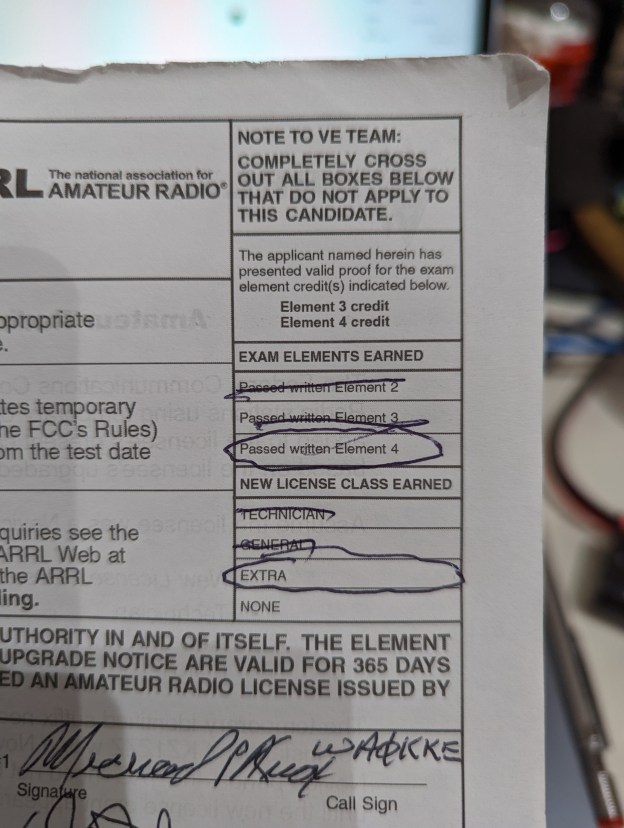
Amateur Extra Baby!

I upgraded my privileges to General Class back in 2009 and have meaning upgrade to Extra ever since.

Well, tonight – some 13 years later – I finally did.

UPDATE 2022-05-09

It finally updated in the ULS system today. Looks like as of May 2022, it is taking approximately 2 weeks for updates to go through (assuming that the VEs filed within a day or so of my passing)
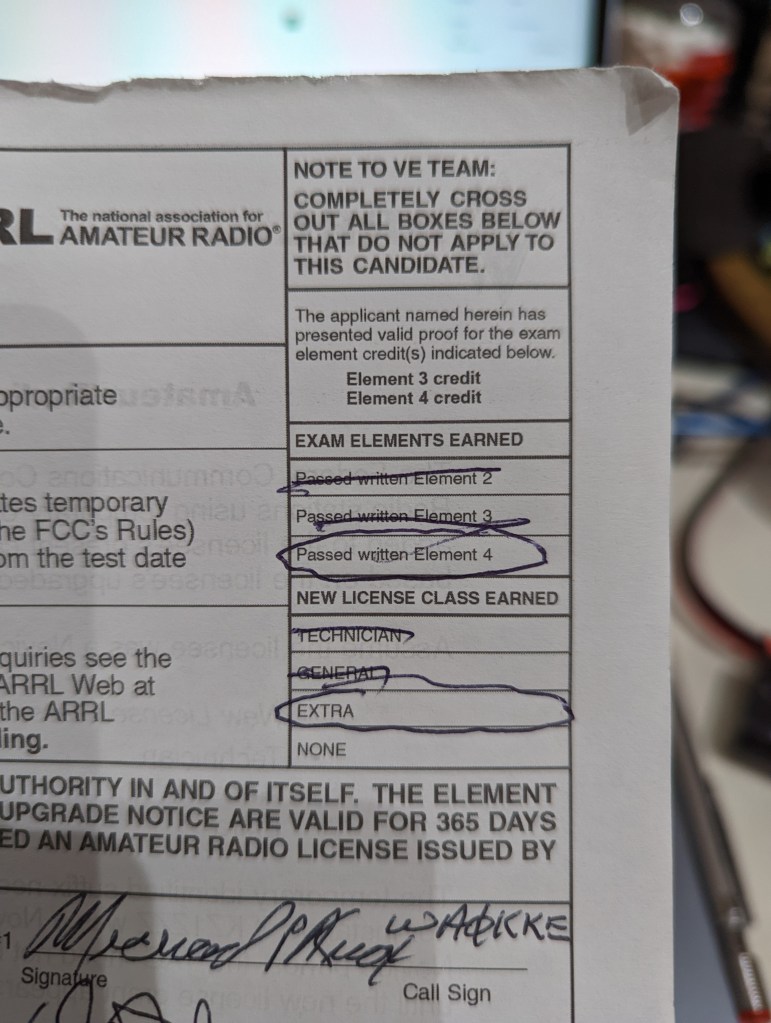
I PASSED MY EXTRA CLASS EXAM TODAY!

In the course of studying for this exam, I tried about everything I could get my hands on to not just learn the answers, but to try to understand the ‘why’ behind them.

As such, I’ve gained some perspectives on the various options out there to prepare for this exam, and I’m going to share a few with you.

Books

ARRL Extra Class License Manual (link)

The ARRL Extra Class Manual is THE book. It details not only what the question pools are, but why the answers that are correct, are…well….correct. In many ways it is more than a study guide, it is also a reference manual of sorts.

I am not one of those who can start at the first page of a manual like this and just start reading, so I found it to be an excellent reference as I was moving through the various sections of the question pools.

Well written, but if you don’t have a math or technical background, you might need to reread some things multiple times to put two and two together.

Pass Your Amateur Radio Extra Class Test (Amazon)

This book seeks to shortcut your exam prep by ignoring all the wrong answers in the question pool, and only focus on the correct ones.

The bulk of the books are the questions with associated answers. There is sometimes a bit of explanatory text such as “Message forwarding stations (like Packet) are usually automated. If a station forwards a message that violates FCC rules, the control operator of the originating station is accountable for the rules violation” – pg. 14

Good for quick study sessions for drilling high level concepts, but not for anyone who wants to dive deeper.

Apps (Android and Apple)

Ham Study (link to their portal for specific app stores)

This quickly became my app of choice.

Why?

There are other popular apps out there that I actually started on and spent hours using every week. The problem with the others is that their randomized questions seem to omit roughly 40% of the actual question pool. I did so many practice tests with other apps that I thought I was getting the material, but as soon as I installed Ham Study I found myself bombarded with questions that were entirely new to me.

Ham Study seemed to throw me the most curveballs, which I equate to its effectiveness in ensuring that I was best prepared for the exam.

My personal favorite, and since I started using it I stopped the others, so I’m not mentioning them here.

Sorry 😦

Videos

If you don’t know who Dave Casler (KE0OG) is, you need to check out his YouTube channel. He does a complete Extra Exam Course using his website and associated YT videos.

He has a teacher’s demeanor, and explains things in easy to grasp ways. I have benefitted immensely from his knowledge and the effort he has put into his content.

Check out his Online Help for Self-study (link)

Conclusion

This was not meant to be an exhaustive list of all the things I used/tried, but some of the things that I found most useful.

If you’ve taken any of the FCC exams (Technician, General, Extra), what tools did you find most effective to getting ready?

Let me know in the comments.

Now, I’m waiting for my new privileges to show up in ULS. Until then, I’m KD0HBU/AE.

Whoohoo!
Xiegu x6100 – 20220418 Firmware Update

The folks at Xiegu have released a new firmware update for the x6100 HF transceiver.

From the changelog:

New firmware version information is as follow after upgrade:
APP  : V1.1.5 Apr 10 2022,13:12:01
BASE : V1.1.5 Apr  9 2022,17:14:40

For all the previous fw download, visit < www.radioddity.com/x6100-firmware >
-------------------------------------------------------------------

2022.04.18 Upgrade Log
Main file: sdcard.img
SHA256: C6CDE4E7546842C7693D2A20B193D18017F2C17C4F644D56A36218CD22836B41

App: V1.1.5 Apr 10 2022,13:12:01
1. Fix bug: the last character in the string of "AGC mode" is half cut off in MEMO mode
2. Fix bug: CW decoder not working 
3. Fix bug: incorrect UTC offset/Time zone
4. Change the range of built-in/handheld speaker's MIC gain:
   Old version:  range 0~36, default 10; actual gain 0~+18dB, step 0.5dB
   This version: range 0~50, default 20; actual gain -10~+15dB, step 0.5dB

Base: V1.1.5 Apr  9 2022,17:14:40
1. Fix bug: battery can't be fully charged
2. Fix bug: won't charge at power off state (occasionally)
3. Fix bug: have to switch band or press PTT once at the first time of power up, or there's no output RF power
4. Fix the problem that the built-in/handheld speaker's MIC gain is too high
5. Fixed the problem that the gain adjustment of the built-in/handheld speaker is not obvious

You can pick up the files at https://www.radioddity.com/pages/xiegu-download

Please do note that upgrades are a two-step process – upgrade of the system software and upgrade of the baseband. The second step will fail if you are not plugged into external power.

Funerals, Road Trips, and Navigating Changing Plans

While I did get a quick QSO in this last week, this post is less about Amateur Radio and more about accepting and navigating life’s changes.

It is of a more serious type and you may choose to skip this. It is long and rambling.

Your choice.

In late February of this year a close friend of our passed away, succumbing to her second bout with cancer. The day before she was admitted to the hospital for the last time, she and my wife were together discussing upcoming vacation plans and our two families plans to head out to Yosemite later this year.

Like us she was in her mid-40’s, and that day was upbeat, feeling good, and going strong.

Our sons are best friends, and I’m grateful to have known her through them over the last few years. She and my wife had very similar kinds of cancer, and seeing her recurrence hits home in very personal ways. They were able to connect in ways that many of us cannot relate to, and quickly became good friends.

The next day she was rushed into the hospital, sedated, and her family was gathered together to say goodbye.

Early the next morning she was gone, leaving her husband and two young children behind.

Plans made.

Plans changed.

The day after her funeral service – with some heavy thoughts in my mind – I hit the road with my two younger sons to visit their grandparents who retired to southern Utah.

It was a chance to refocus on family and things that matter the most.

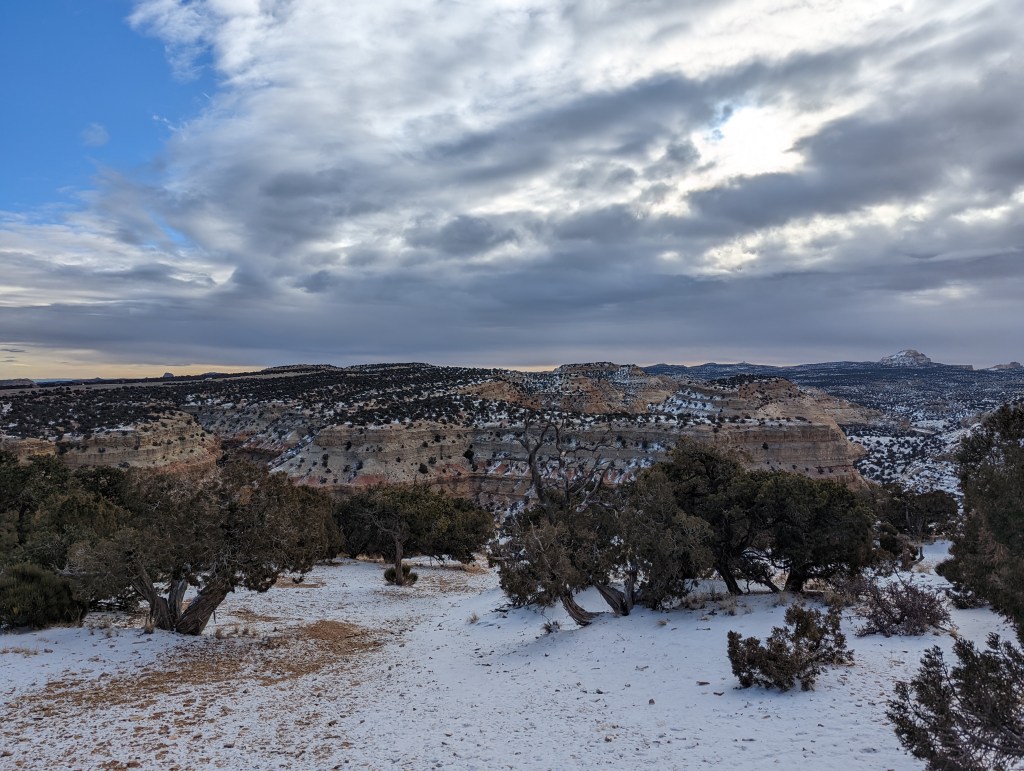
Over 1500 miles each way is a long, but beautiful commute through some spectacular landscapes

The plan was to take one very long first day from Minnesota into Denver, CO., and then a shorter second day into southwestern Utah.

We left extremely early in the morning, hoping to reach Denver around dinner time and be able to relax and decompress from a long day in the car.

I brought my TX-500 and MPAS Lite with the hopes of even getting some on-air time along the way. Interstate Highway I-70 tops out at over 11,500 feet of elevation (3500 meters), and with multiple rest stops I thought I might be able to put an antenna way up high and see what I could do with just a few watts.

Plans change.

We headed south through Iowa, passing through Des Moines just a few hours prior to a pair of tornados passing through and killing 7 people.

Weather was mile during our time through that state and we didn’t have any knowledge of those events until much later.

Nebraska is my least favorite state to drive through. I don’t mean any offense to any residents there. It isn’t personal.

It’s just that it is a very wide state.

And mostly flat.

And the longest straight line of the journey.

It is a long, slow climb that culminates in the foothills of the Rocky Mountains, with mostly farmland on either side of the road and the occasional smells of cattle.

About halfway through that long haul we hit some weather. Wind blown snow began to cover the road, and ice started to build up on the pavement.

Cars began to pile up along the road side as too much speed contributed to too little traction.

Choosing safety over speed, we inched along at about 1/4 of our planned speed.

Arriving in the city of North Platte, we stopped to fuel up and stretch our legs.

And were promptly stuck in a long line of vehicles trying to get into a gas station, blocked by a big rig stuck in the slush and ice.

We sat for about 40 minutes as crews worked to get it moving again, all so that we can get into the parking lot and off the road.

Our planned timeline slipped further and further away.

Plans change.

When we finally got back onto the highway, we saw the remnants of some big crashes that were in the last stages of being cleared. Had we been able to continue as planned, who knows if we would have been caught up in it or not.

Plans change, but sometimes it is for the better.

We arrived very late into Denver, getting checked into our hotel and settled in for a late bedtime and a very early morning.

The forecast was for snow flurries, with little accumulation.

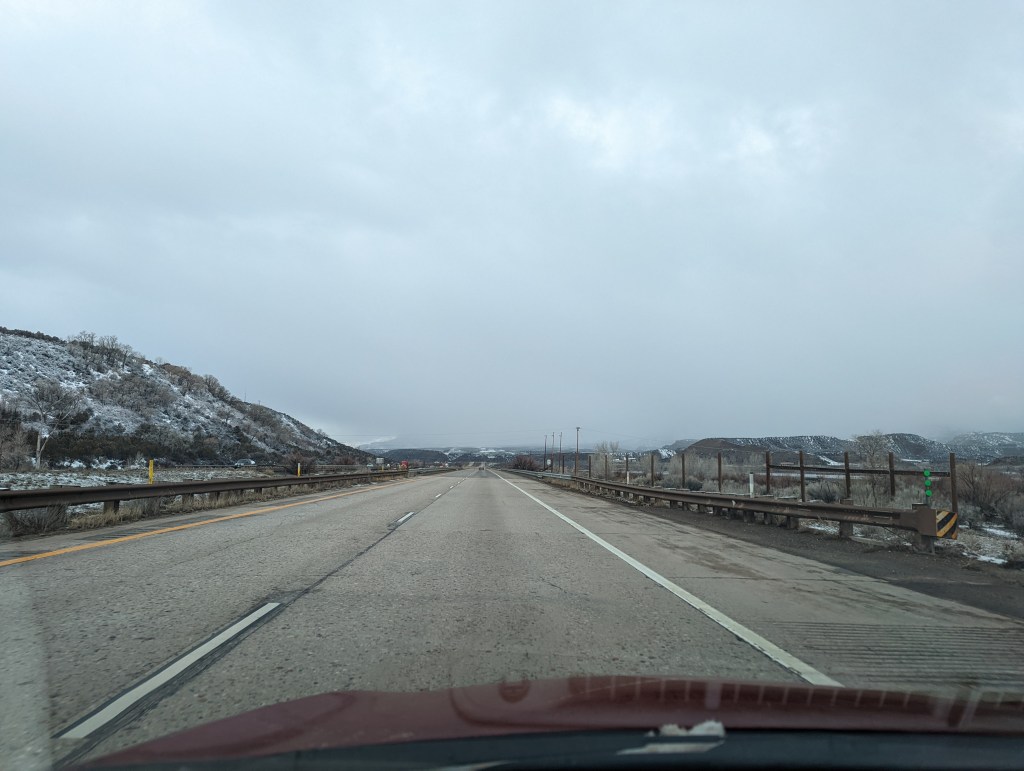
We awoke to thick blowing snow, and this next leg was the start of the climb into the highest parts of our journey.

Roads were caked with snow, the wind was blowing, and it was a slow procession of vehicles up the canyon.

To make an already long story a wee bit shorter, we did arrive at our destination safely, but it was altogether a very different journey than we planned for.

And needless to say I didn’t get any POTA/SOTA contacts along the route, nor did I get to see what propagation is like at 11,500 feet.

Weather moved in again a couple of days later and instead of leaving on the date we had planned for to get me back to work on time, we had to push our departure out a day, move plans with work accordingly, and adjust ourselves to the new reality we faced.

Plans change.

The point of this post is that we cannot foresee what will come both now and in the future.

While what happens in our lives is of great importance, it is our ability to navigate those changes and impacts that matter the most.

We can succumb to the changes and let them overtake us, or we can choose our responses and take ownership of the new direction.

That isn’t to say that we control the directions we are sometimes forced to take, but we can control our response to events and work to figure out how to grow through the process.

In spite of all the challenges and changing of plans, we enjoyed spectacular views and wonderful time with family.

We learned, my sons and I, that adaptation is part of the journey of life. No plan survives first contact with reality unchanged.

Plans change, and so do we.

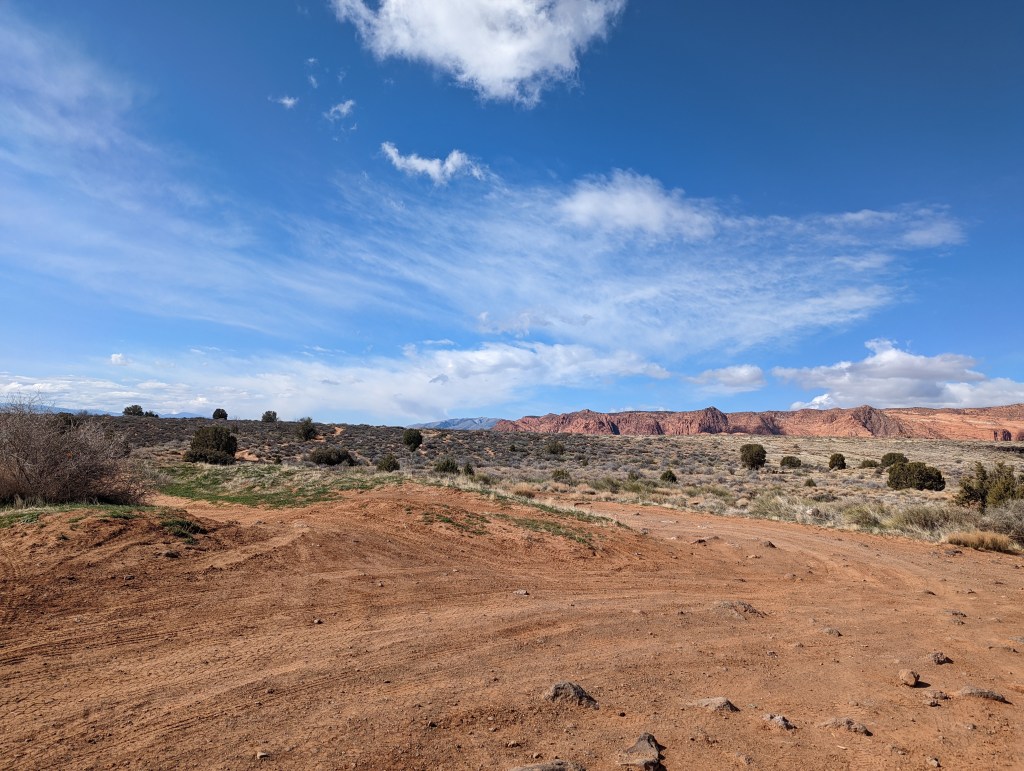
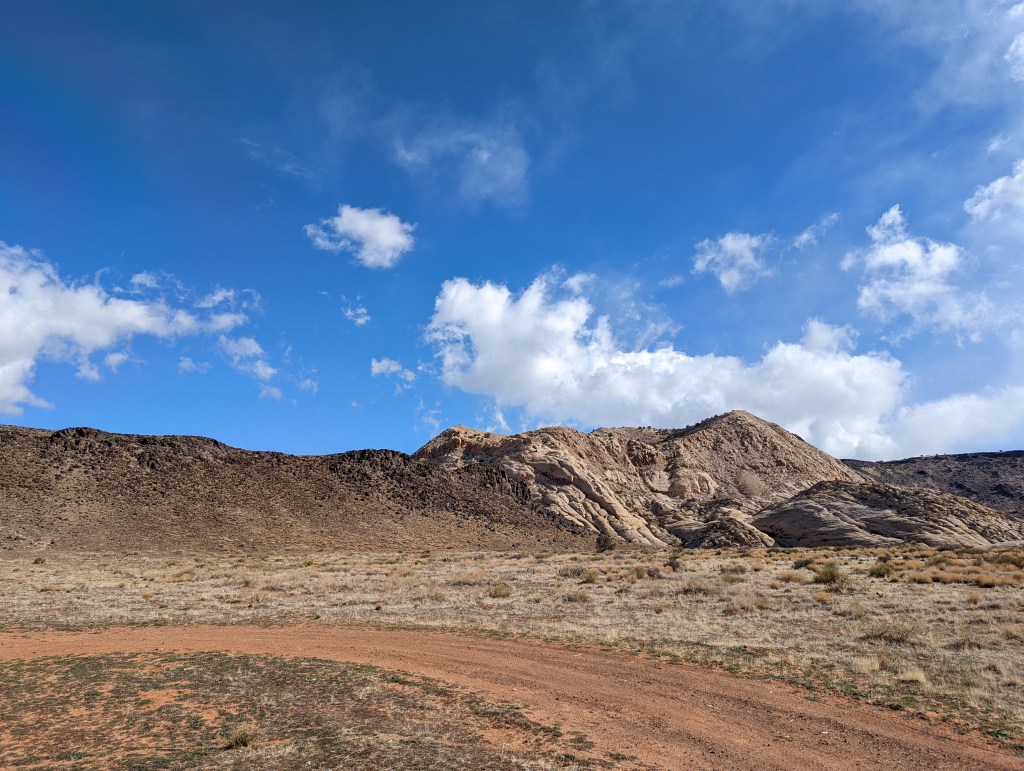
Now some photos.

Hams in Ukraine

Photo by Olga Subach on Unsplash

With the current events in Ukraine, the International Amateur Radio Union posted this notice:

Any radio amateur currently transmitting from Ukraine is risking his or her life. If you hear a Ukrainian station, do not broadcast its callsign, location or frequency — whether on the band, in a cluster or on social media. You may be putting lives at risk.

Source: DARC HF Committee via facebook

This comes shortly after UT3UY Anatoly Kirilenko of the Ukrainian Amateur Radio League posted a note, quoted by www.qrznow.com, stating in part that:

Martial law has been imposed in Ukraine today.

There is a ban on the operation of amateur radio stations for 30 days …

No matter where you are in the world, or your political stance on recent events, the people of any nation in conflict are always the casualties of war.

Language Learning and CW

I’m 5+ weeks into the Intermediate course from CWOps (having completed the Basic course last fall) and I’ve been contemplating my learning path lately and how it relates to spoken language learning.

WARNING: This will be more of a brain-dump style post with lots of rambling on and on.

You’ve been warned. 😉

Through high school I studied Mandarin Chinese. All 4 years. My teacher wasn’t much of a teacher. He was tenured (or whatever the equivalent was for that level of educator) and didn’t care much about our learning as much as drawing his paycheck. He did, however, really like high school girls which is why the majority of his students didn’t get scores worth the work they put into them – unless they were cute that is.

I wasn’t cute (nor am I now).

I also wasn’t a high school girl (nor am I now).

About the only things I remember learning in his class was how to swear in Chinese and that some Chuck Norris movies have nudity.

Seriously awesome as a teenager to have a teacher show movies all semester.

That isn’t the point I guess. The point is that I really didn’t learn how to speak, read, or write Mandarin until I found myself living on the island of Taiwan at 19 years old.

Photo by Mark Ivan on Unsplash

Taiwan is a beautiful albeit crowded place, filled with wonderful people and amazing food. I spent two wonderful years there learning and growing as a person.

I’m getting hungry just thinking about my time there…..

Photo by Andy Wang on Unsplash

I was fully immersed in the language, people, and culture and found my language skills exploding.

You see, I had to use it daily if I wanted to get around.

Many people were learning English. It is taught in all the schools and just about everybody wants to practice some words with you. Even more important to a language learner like myself, they all were extremely willing to be patient with a foreigner trying to speak and hold a conversation in Chinese.

They were also quite forgiving as some words, if spoken with the wrong intonation, can have some embarrassing outcomes. (My worst was 引導 (Yǐndǎo), which means guide, but if the tones are wrong refer to female genitalia. Couldn’t figure out why they were giggling so much until much later.)

Yeah…..languages are fun 😉

I carried a small notebook with me everywhere and wrote down common Chinese characters that I saw during my day. I would rush back to my apartment each evening and spend time reviewing my list, looking them up in my huge dictionary, and making notes on pronunciation and meaning in the margins.

The next day I would go through the same process again, only I would also be looking for the characters from the previous day and making sure I could recognize them when I saw them.

Within about 6 months I was able to read common words and phrases to navigate the city I lived in, and by the end of my first year living there I could pick up a newspaper or magazine and understand most of what I saw.

Immersion is key to language learning.

I’m using this example and juxtaposing it with learning CW because with both, there is an association of something that doesn’t look or sound like what we already understand (Chinese words don’t sound like my native English, and CW doesn’t sound like ABC’s).

Ok, maybe not an apples-to-apples comparison. More like an apples-to-antelopes one.

Mandarin is a natural language, one that is spoken by millions world-wide and all languages (that I know of) have word-for-word associations with my native English, or at least some phrase or meaningful equivalent if not word-for-word

CW is a way to spell words, which at higher speeds can become more about word recognition than character recognition, but it is still individual characters being sent.

People don’t go around spelling out their words in English to each other.

“H-E-L-L-O<space>K-D-0-H-B-U<space>H-O-W<space>A-R-E<space>Y-O-U-<..–..>”

And Mandarin is even less about spelling as characters themselves are whole words. No phonetic spelling. While they do have “bo po mo fo” to help teach character recognition, it isn’t an alphabet.

But bear with me.

The process of learning the alphabet in CW is a fairly quick one. I say fairly quick because unlike learning a new spoken language, you already know the letters. You just need to associate the alphabet characters with a new sound.

While there are many methods to picking up the basics, they usually involve repetition of the characters individually at first, then combined with others.

Some methods involve starting with whole words.

Choose the method that works best for your learning style.

My notebook I carried around every day, jotting down new characters and referencing ones I had already seen before is similar to taking recorded CW sound files (https://morsecode.ninja/ – seriously though, bookmark that site!) with me in the car or walking the dogs. The MP3 files with the “CW – spoken word – CW repeated” allow me to try to beat the announcer and if I don’t, have a follow up that reinforces the correct character or word.

Once the ABC’s were understood and I had a relatively good level of confidence in recognition there, I would make a point of taking the street signs along my path and vocalizing dits and dahs to sound them out as I go.

Morse Code Ninja has many, many files available which include some to build upon the alphabet with two-letter words, three-letter words, common QSO words, and more. All at speeds from 15 to 50 words per minute.

My goal the last year has been to make CW a part of my daily routine and get to 18-20 wpm on the air. Right now, 9 months in to my journey I am comfortable at sustained 15-16 wpm on the air (real speed, not Farnsworth), and 25-27 wpm for up to 5 character words (Farnsworth).

CWOps helps a ton with that goal, providing a structured program and twice-weekly sync ups with others to ensure that I get feedback and tips. My progression accelerated substantially after 4 months of learning on my own once I got into the course.

Progression in CW, like in language, is a function of time spent immersed in the practice. Fortunately you don’t need to travel to the other side of the planet to become immersed.

Just down to your shack.

How much time do you spend each day hearing others sending CW on the air?

How much time do you spend on the air sending it yourself?

In other words, how immersed are you?

I haven’t done either yet today.

Better get at it…..