Along my CW journey – which I am still trudging along on – I have benefited greatly from Kurt Zoglmann (AD0WE) and his site Morse Code Ninja (link).
Kurt has produced literally weeks and weeks of audio files of various categories in speeds of 15-50wpm (*gulp* – that speed just sounds like noise to me still), all of which is freely available for download. You can see the dozens of categories on his Practice page (link).
His YouTube channel additionally has videos of the audio files so you have multiple options for playback.
Example Video
Given how many hours I’ve spent using his work over the last year plus of my learning CW, and how many others I’ve spoken with that have also benefited, I am suggesting that a small donation to continue to fund his efforts is a good thing that, if able, you should consider doing.
He has a link to do so on his contact page (link).
No I am not affiliated with him or his site, just a very grateful consumer of his efforts.
Having a software development background I know how time intensive projects like his can be, and for him to put it out there for everyone to use freely speaks to his love for the hobby and desire to grow it even more. Hosting a website and having bandwidth for file download isn’t cheap, and I like to encourage people like him to continue so that we can all benefit for years to come.
Waiting for SpeedPak packages from China is something that builds virtue.
SpeedPak. lol
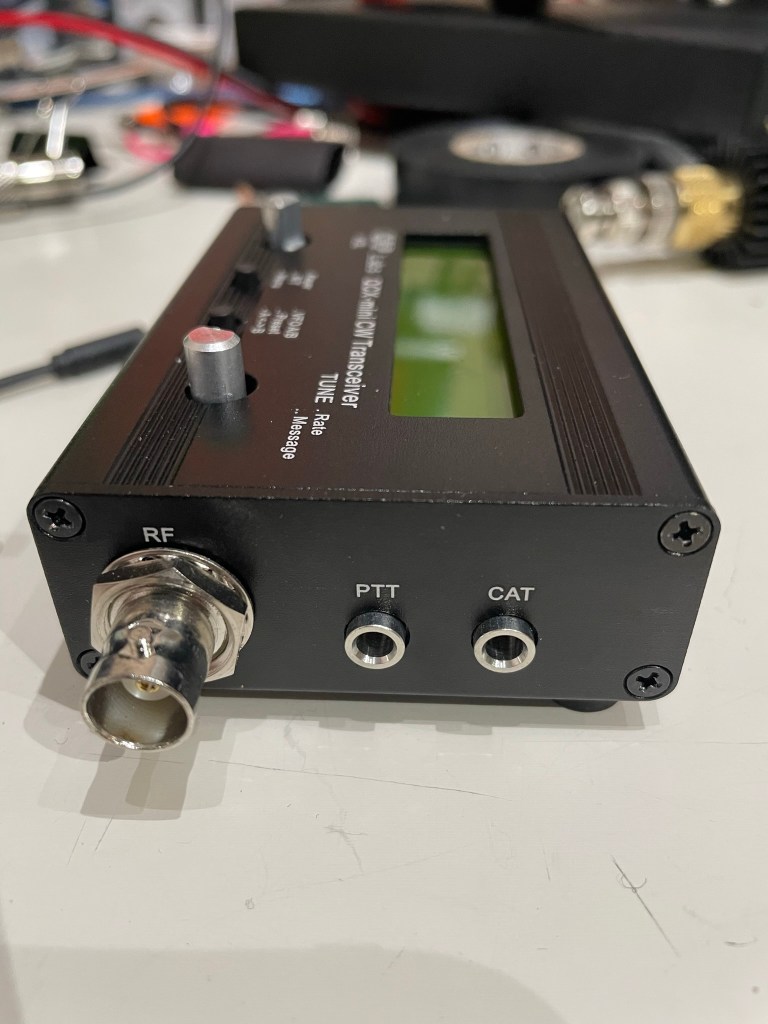
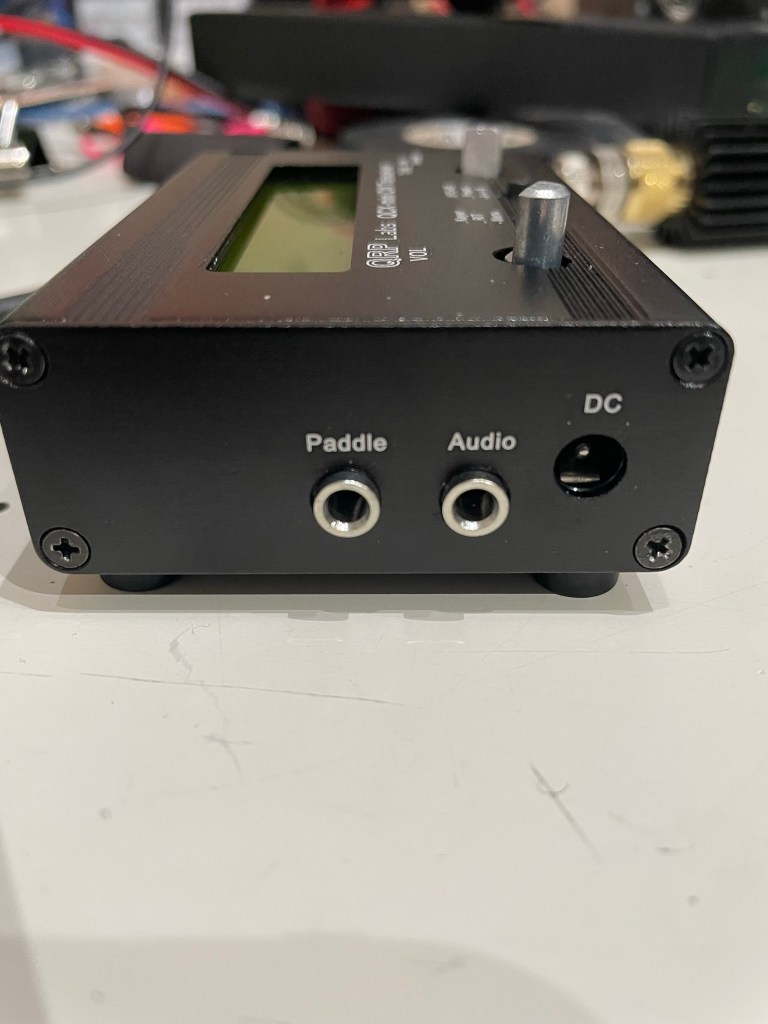
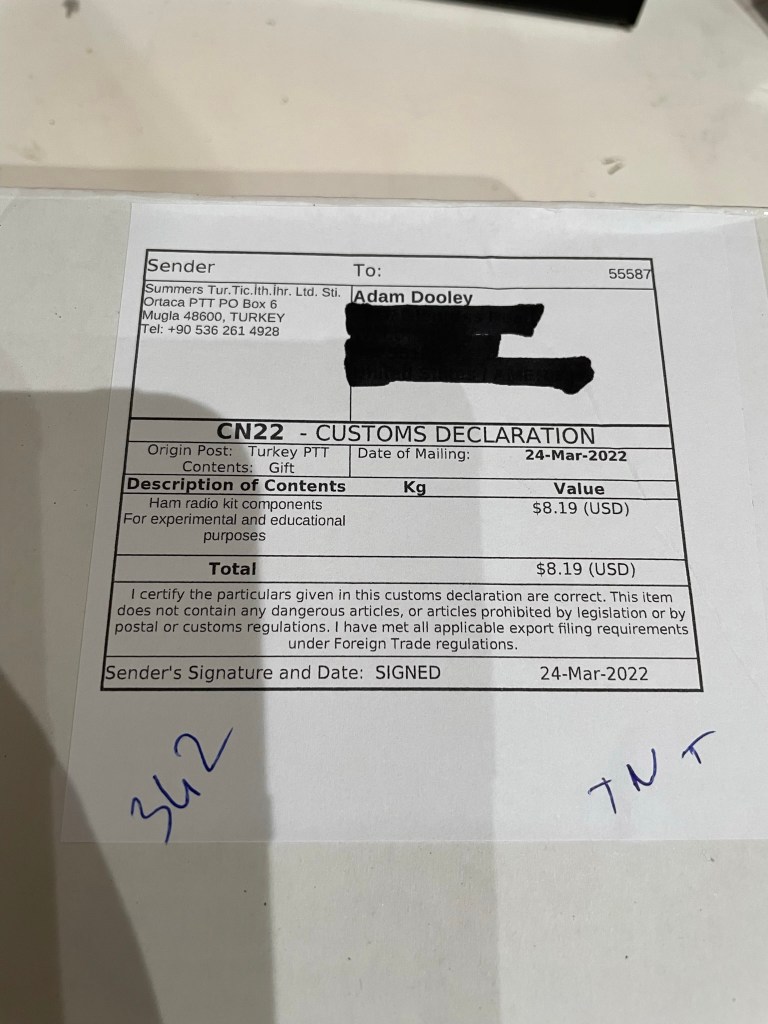
For everyone’s reference, I’ve ordered a (tr)uSDX kit from a Chinese distributor, one of the few that are authorized by DL2MAN and team per their forum post at https://forum.dl2man.de/viewtopic.php?t=139
You can read more about the project at DL2MAN’s website https://dl2man.de/
Actually I’ve ordered two – one preassembled and one that is a kit. I will 3d print the case and assemble the kit from scratch.
I went this route since sourcing components is very difficult right now – the PCBs are easy enough (you can order directly from a PCB maker or even find local folks on Ebay who have done so for group buys) – but parts like the Atmega328P-AU or 74ACT00 are hit and miss at major suppliers.
Some folks have taken to buying electronics with said parts and desoldering the components to get all the parts together.
I chose to order everything all together. Probably a bit more expensive than I could have done if parts were available, but……
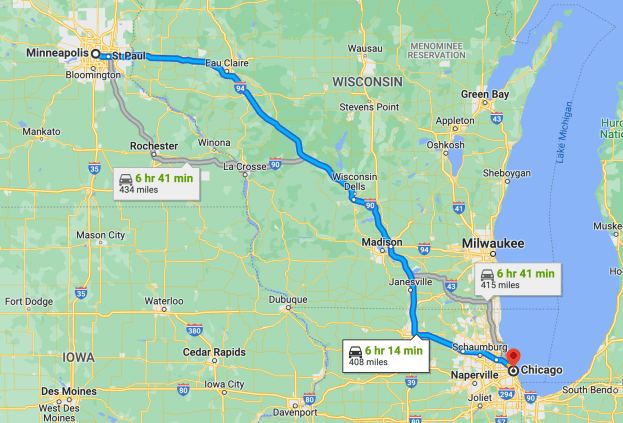
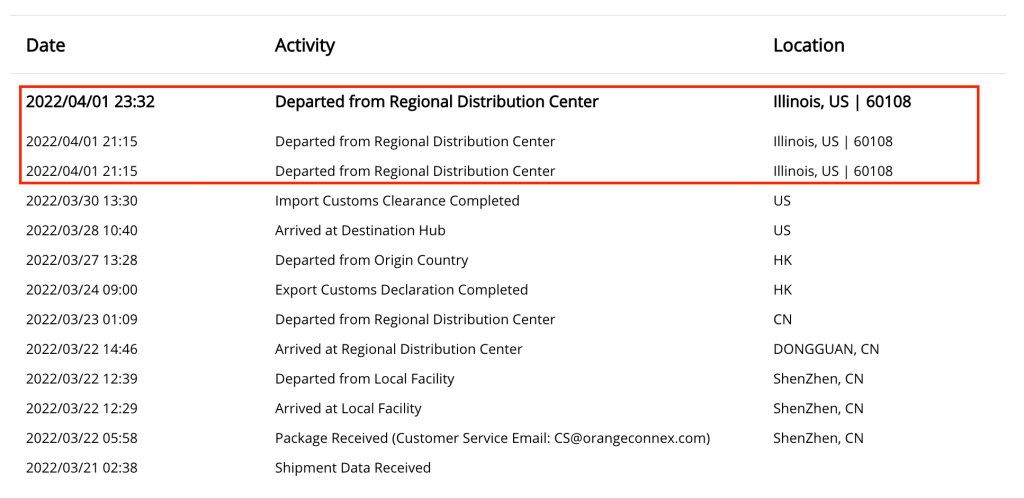
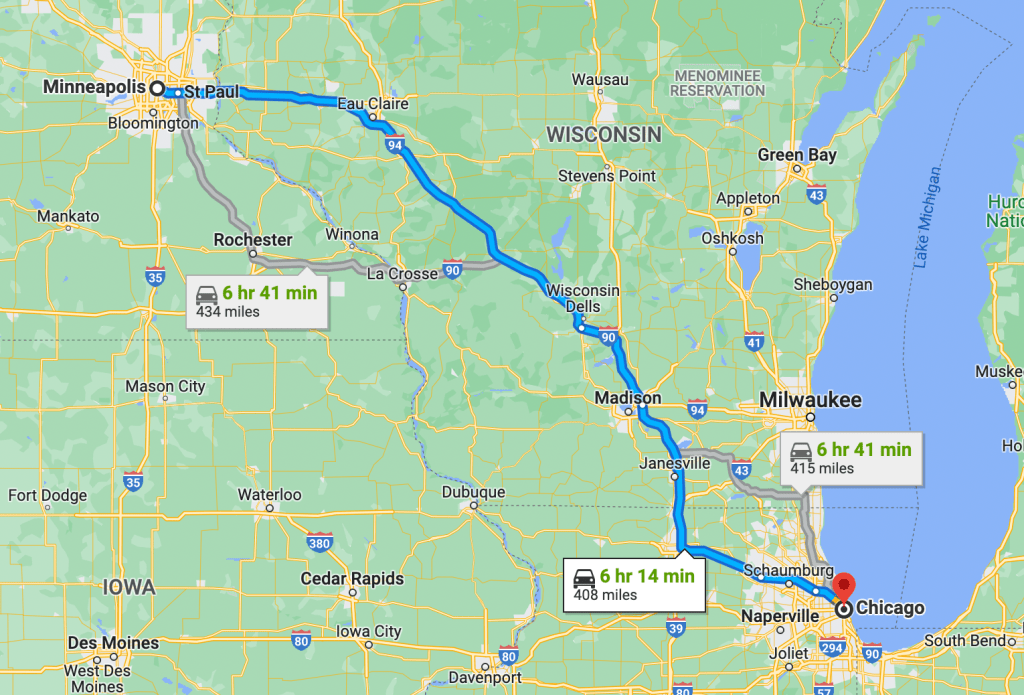
But I’m just sitting here waiting. It is a long wait for things to sit in such a status as shown above. I live roughly 7 hours from Chicago (the assumed hub for such distribution centers), and today is April 6th.
It arrived at that hub on March 28th and cleared customs on the 30th.
Getting a little (im)Patient 😉
I could have driven there last weekend, picked it up, had a nice weekend getaway with my wife………
In all seriousness though, I’m excited to get my hands on this and get it on the air, and I will be sure to post a review of my experience with it afterwards.
How will it compare to other kit radios I have? MCHF? QCX-mini (CW only, but the heritage is there)?
How will it compare to commercial QRP radios like the FT-817 or the MTR-4b?
Now to be patient…..
UPDATE
So after posting this, I sent a quick email to their support address asking if there was any update they could provide.
Exactly one hour later they posted an updated status – in Chinese – that says the same thing the previous status said.
Today, it is out for delivery.
Coincidence?
😀
Update Part 2
Received it and have already had it on the air. I am putting together all my findings and will update with a new post soon.
Yesterday I posted about my latest QCX mini kit from QRP Labs arriving. I had intended to wait until the weekend do dive into the build, but…
I couldn’t wait.
As I mentioned before, QRP Labs publishes incredibly well done documentation in their build instructions. You can see the latest version as of this writing here.
I ordered about a week prior, and it arrived via FedEx delivery in good shape and with everything well packed.
The kit is not necessarily difficult if you’ve built similar radios before, but I do recommend reading the manual through one time before starting. Everything is straight forward, but after a couple of hours of huffing solder fumes, it is easy to miss something and having read it first keeps things in mind along the way.
After taking stock of all the parts, I simply followed the manual step-by-step.
This is not a “how-to” post, rather a pic heavy of the steps I took when assembling.
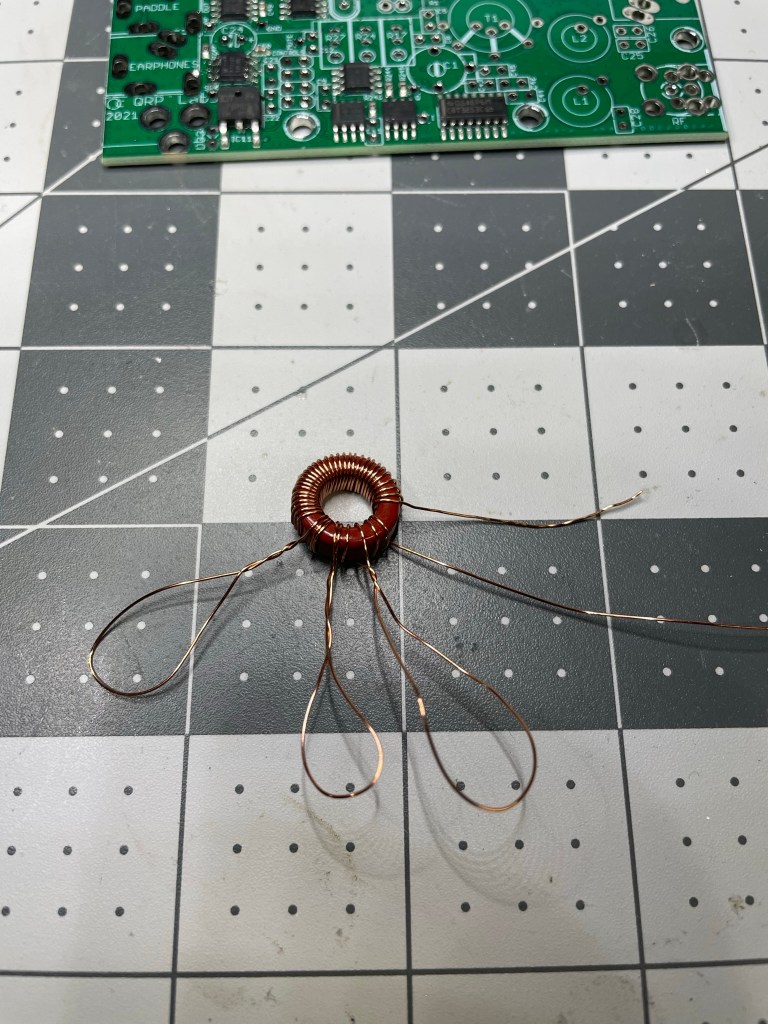
First up is the *dreaded* T1 winding.
For 20 meters, it is 3×3 turns, with 1×30 turns
Actually T1 is really straightforward and simple to wind – if you read the instructions! The main point of the way they instruct you to wind it is so that all windings are the same direction. I think there are two in particular that have to match, but it is easiest to match all of them at the same time.
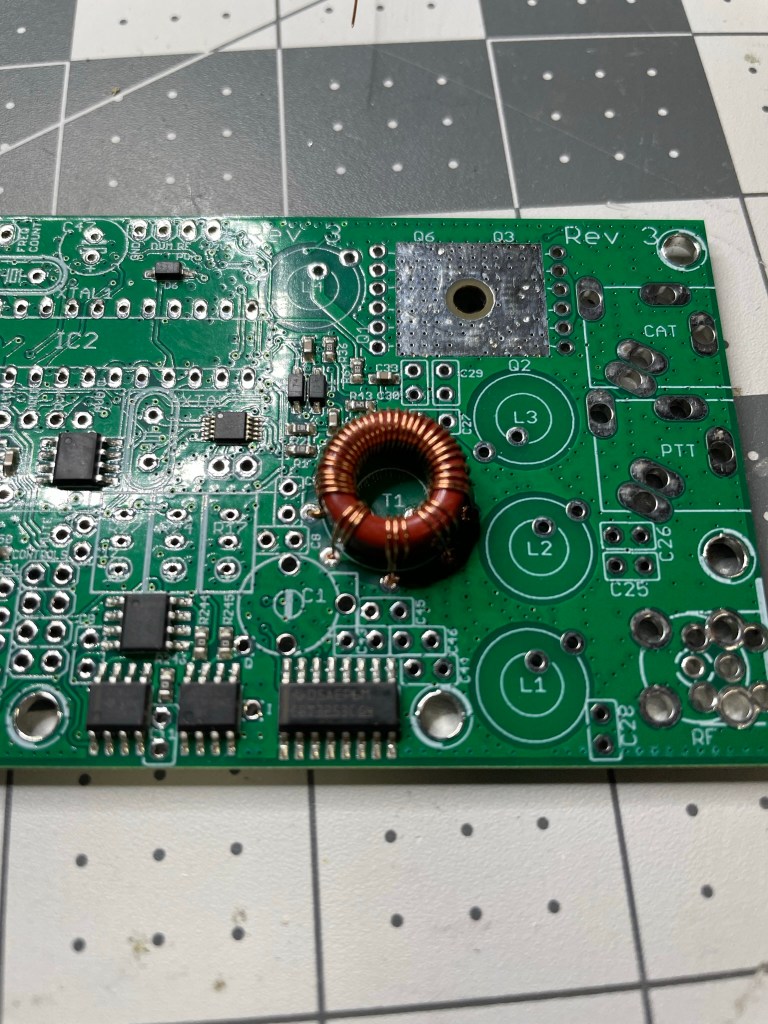
Soldered, checked, and ready for the next steps
With so many leads coming off of the toroid, taking it slow is needed. But again, follow the well laid out instructions and it comes together nicely.
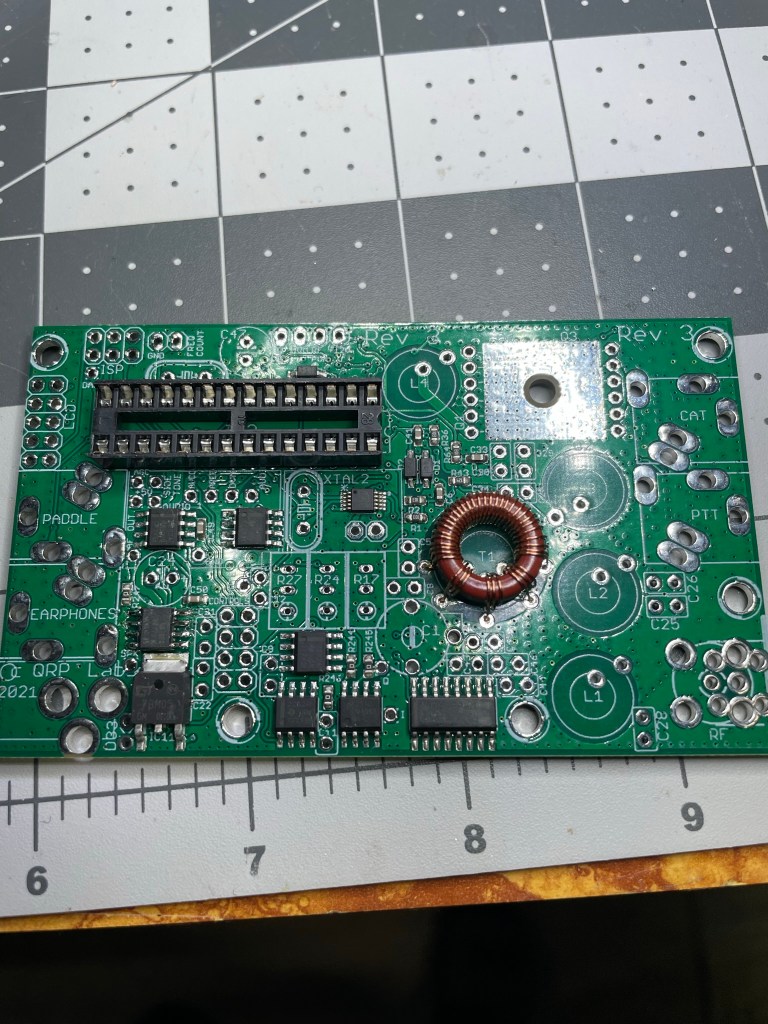
Next up is the IC socket. Simple stuff, just make sure the notch is in the right place.
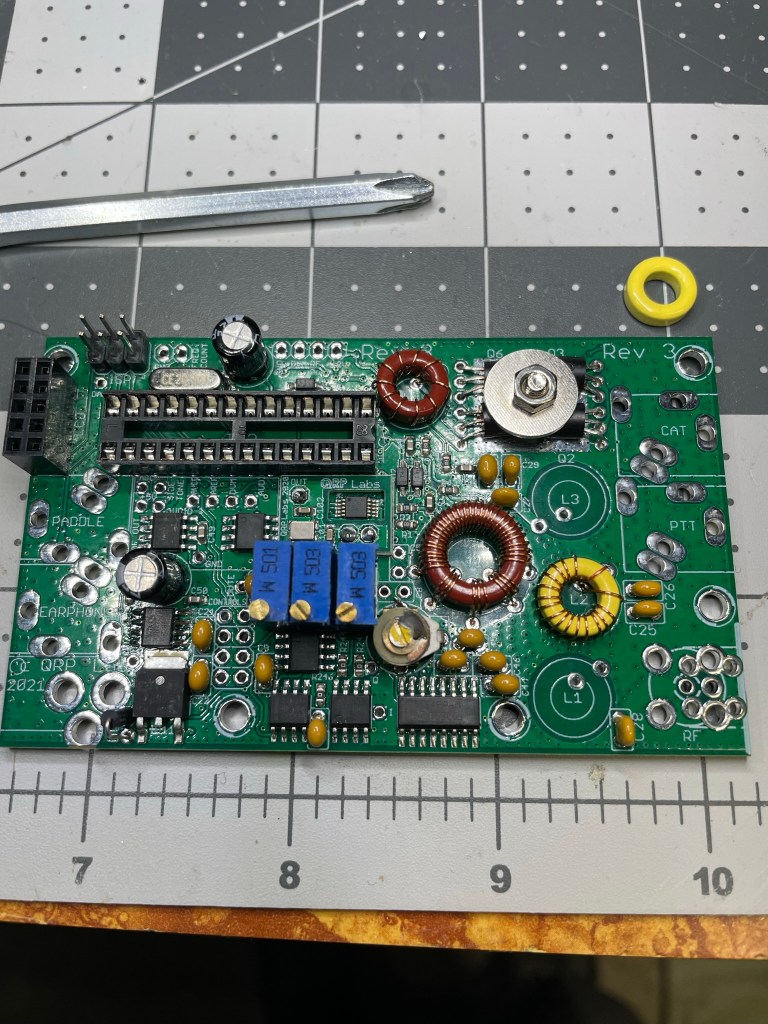
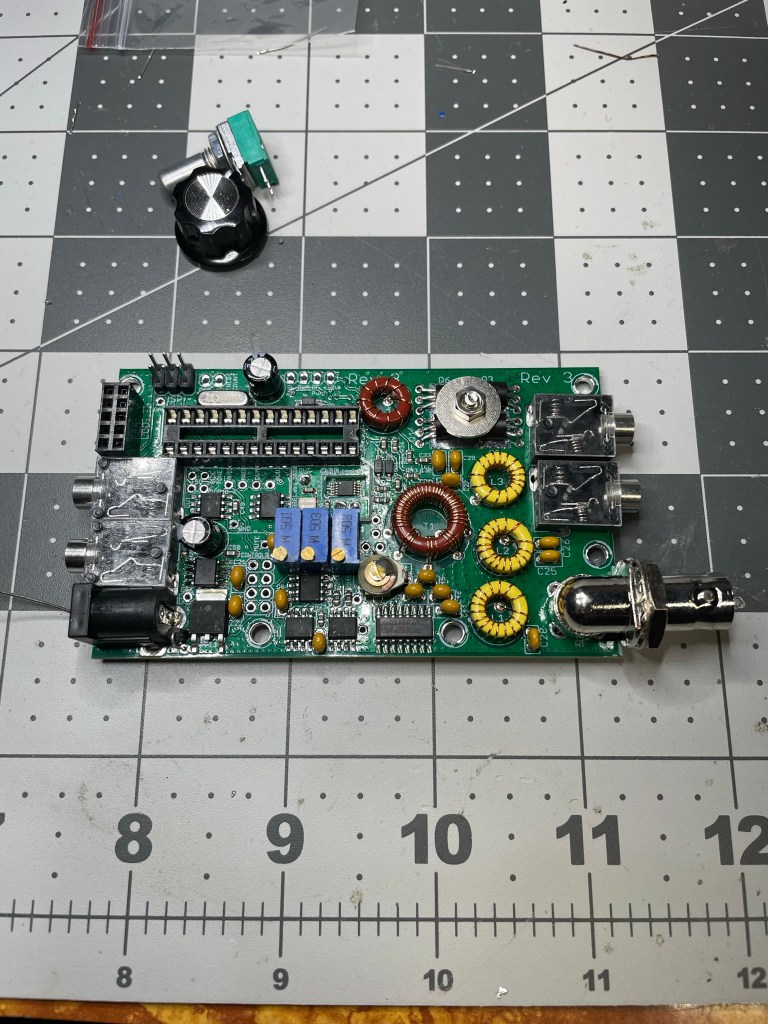
Capacitors are multiplying!Band Pass Filter windings starting to show upMain board is starting to get crowded
The Main Board comes together pretty quickly – there really isn’t a lot of parts to this kit that are not SMD and already on the board.
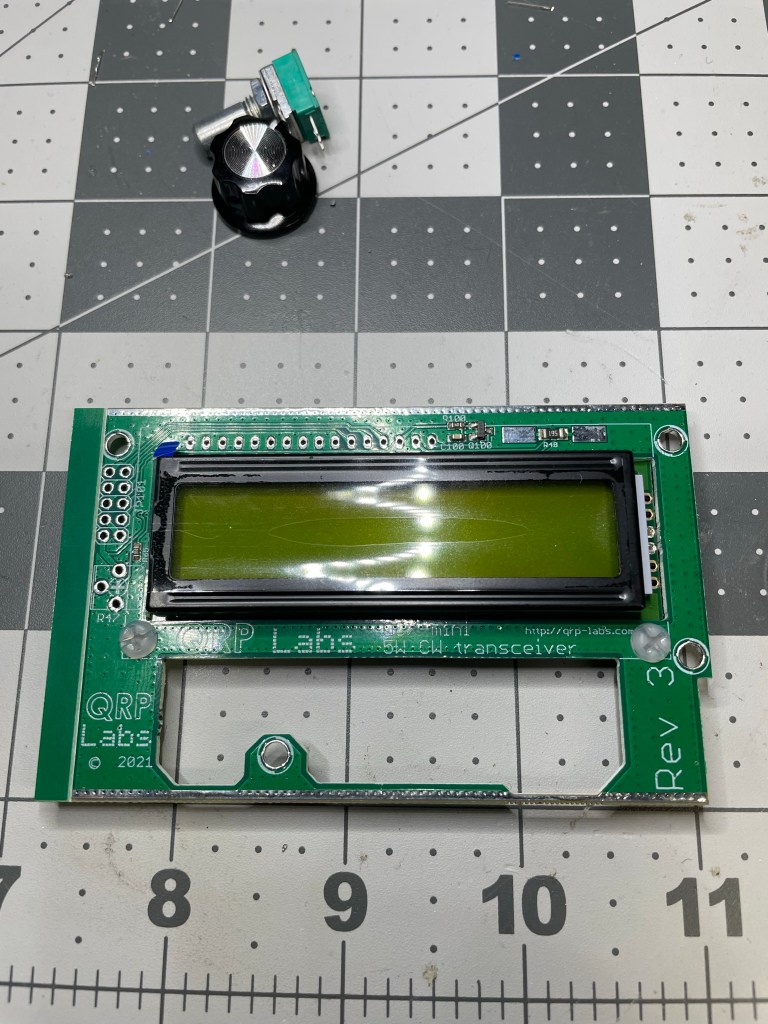
Next – moving on to the Display Board and Controls
The display is secured into place prior to soldering
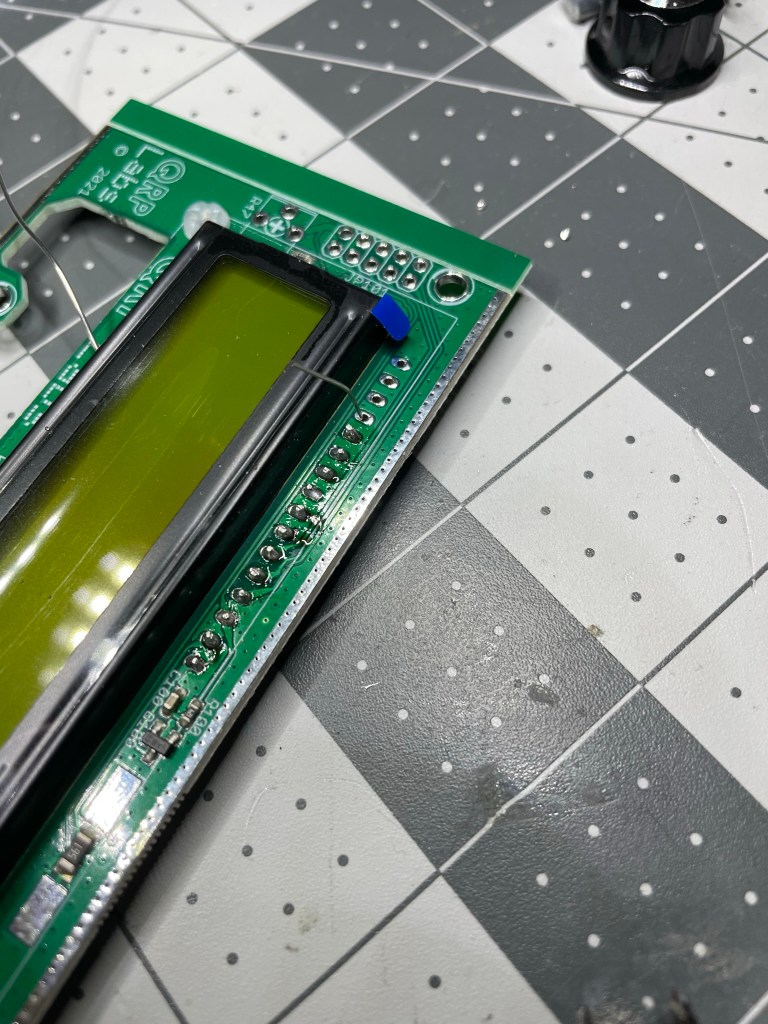
NOTE: Do not toss the clipped leads from the components you’ve already soldered. You will need them for soldering the display leads. Take some of the clippings and use them as connections for the display to the PCB.
Soldering all the makeshift leads is – in my mind – the most tedious part of the build
I failed.
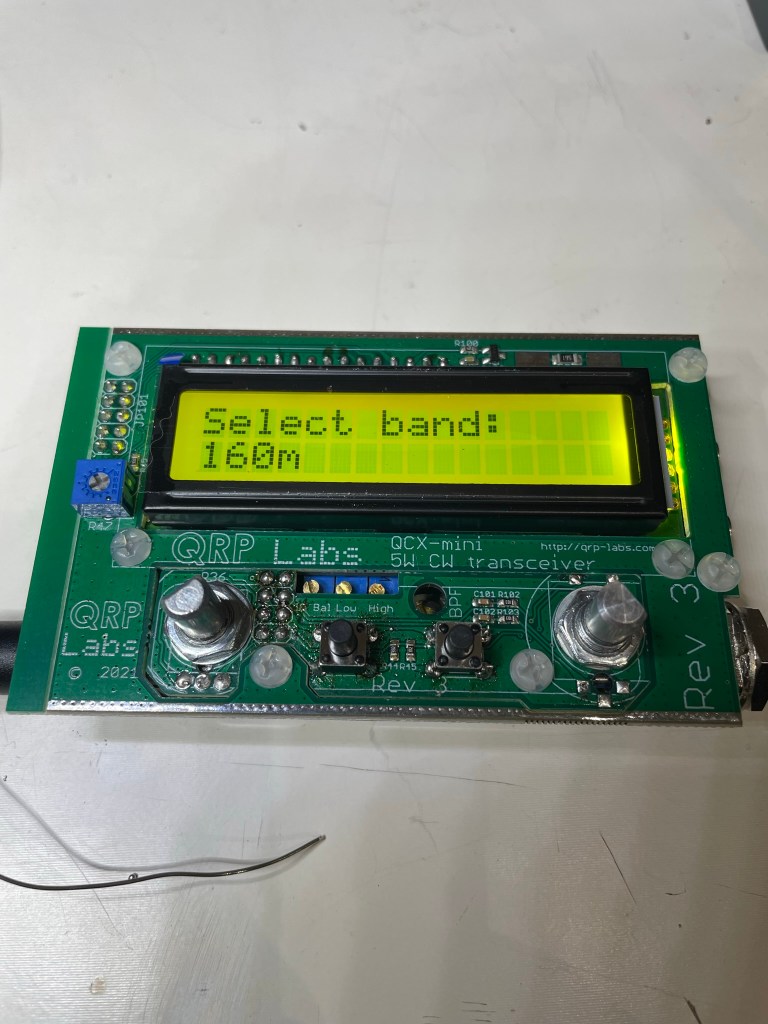
I didn’t remember to take any photos prior to the final smoke test shot below, but it is just mounting connectors and doing final connection checks prior to putting in some power and seeing if we let the “magic smoke” out or not.
Success!!!
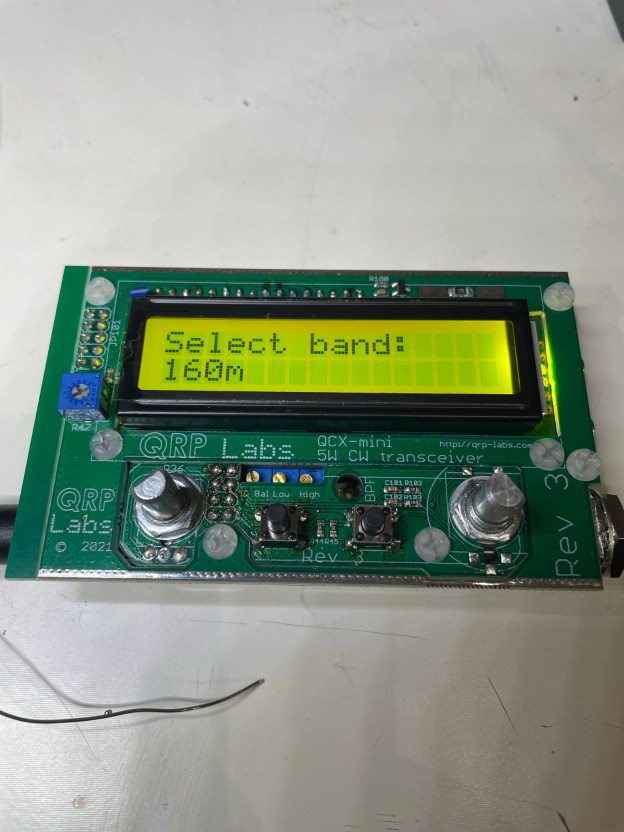
If all goes well, then upon first boot up you should see the above.
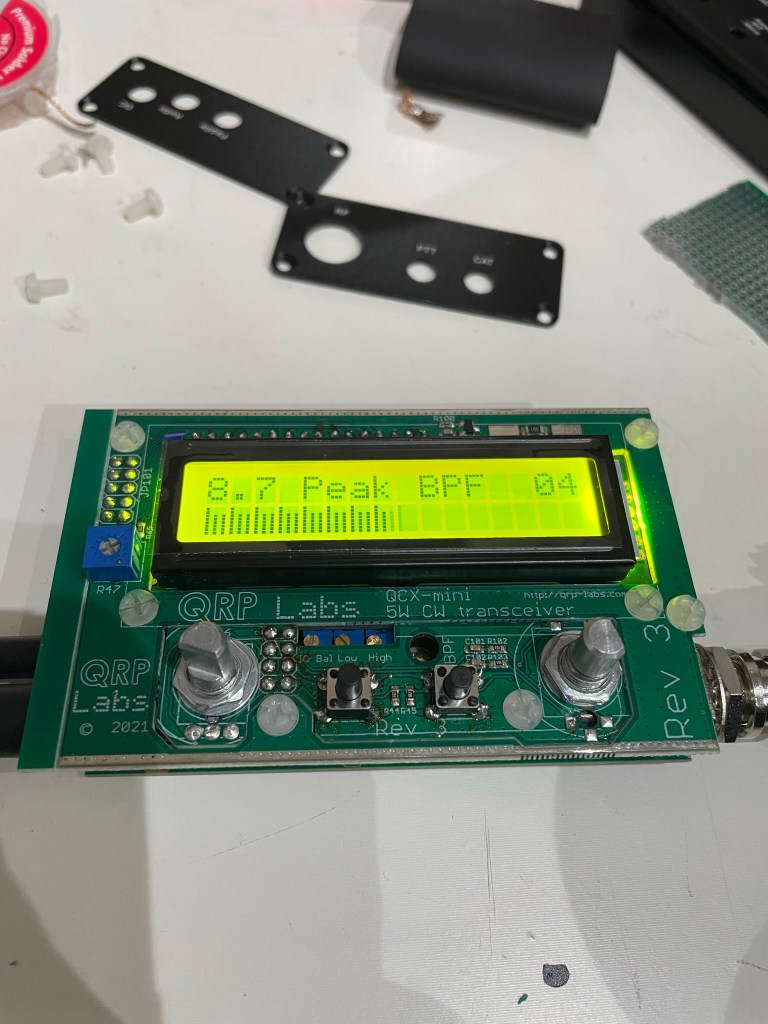
No magic smoke erupted, and it was time to get into calibration.
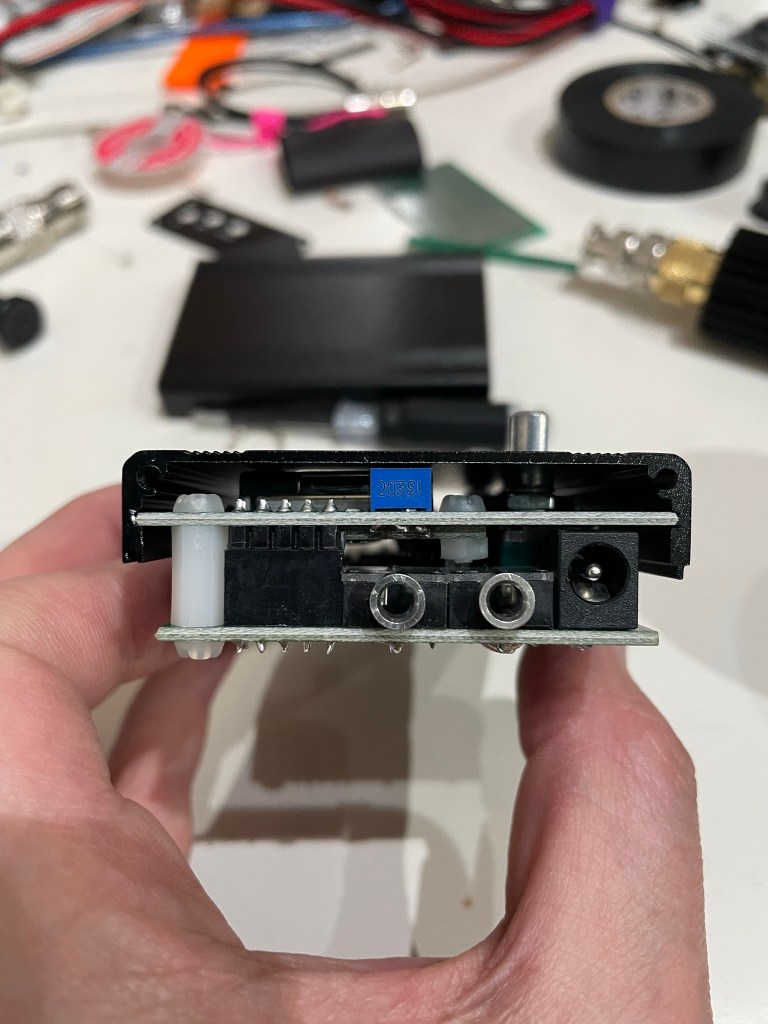
Calibration in progressThe whole QCX-mini “sandwich”. Very tight tolerances, but if you follow the manual it all fits the first time
Due to the tight tolerances of the kit and the optional case, I choose to line the case with electrical tape to avoid any potential of having any contacts cause any issues.
It is also recommended to take a moment to ensure that any soldered leads are closely trimmed prior to casing it up.
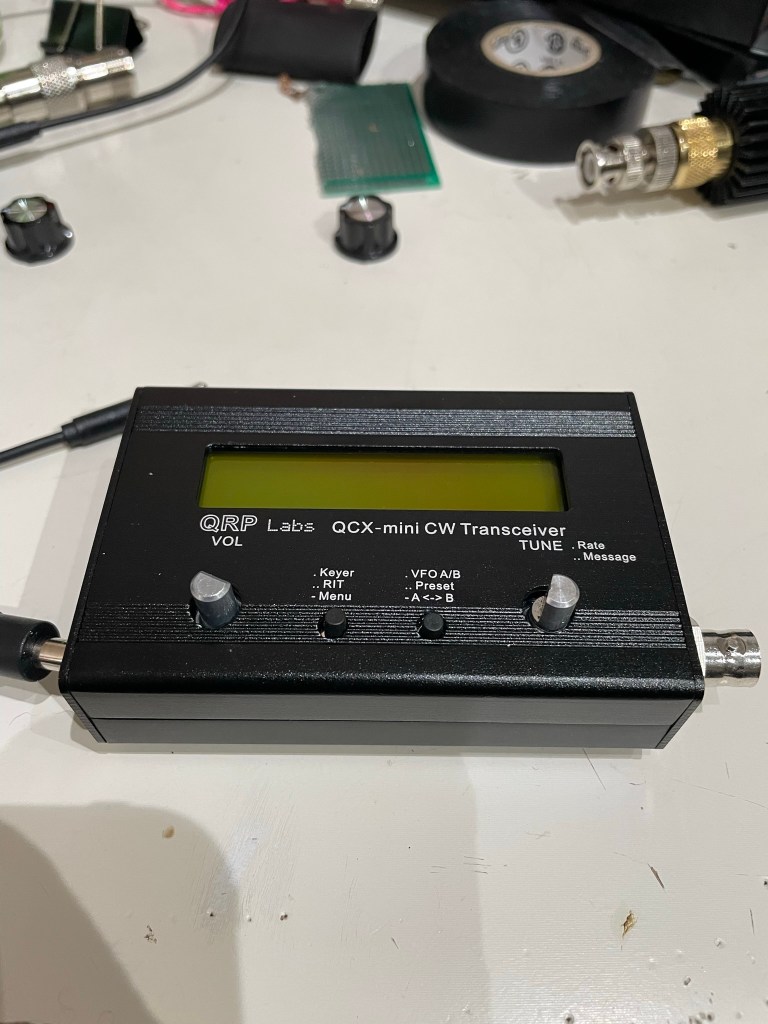
The kit in its new clothing – I highly recommend the optional case for this little radio as it is well made and fits like a glove
Conclusion
I cannot recommend this kit highly enough. They have created a well laid out kit, manual, and final product. The size of this thing is tiny – but having full-band CW coverage, with additional modes like WSPR puts it in a category all its own.
If they came out with a multi-band CW rig – even only 20/30/40 meters – they would absolutely kill the QRP POTA/SOTA market.
Even so, for the price and size, having 2-3 of these is not too much. This is my second purchase from them and I’m already contemplating a 3rd.





 kd0hbu