v1.12.08 (2022.03.01)
- Beacon mode fixes
- Fixed Iambic A/B mode
- Extended CW tone frequency range
- FM mode output power increased
- User menu optimization
You can grab the firmware file from here, and the flashing tool (available for Windows, Mac, and Linux) from their downloads portal.
With the current events in Ukraine, the International Amateur Radio Union posted this notice:
Any radio amateur currently transmitting from Ukraine is risking his or her life. If you hear a Ukrainian station, do not broadcast its callsign, location or frequency — whether on the band, in a cluster or on social media. You may be putting lives at risk.
Source: DARC HF Committee via facebook
This comes shortly after UT3UY Anatoly Kirilenko of the Ukrainian Amateur Radio League posted a note, quoted by www.qrznow.com, stating in part that:
…
Martial law has been imposed in Ukraine today.
There is a ban on the operation of amateur radio stations for 30 days …
No matter where you are in the world, or your political stance on recent events, the people of any nation in conflict are always the casualties of war.
I’m 5+ weeks into the Intermediate course from CWOps (having completed the Basic course last fall) and I’ve been contemplating my learning path lately and how it relates to spoken language learning.
WARNING: This will be more of a brain-dump style post with lots of rambling on and on.
You’ve been warned. 😉
Through high school I studied Mandarin Chinese. All 4 years. My teacher wasn’t much of a teacher. He was tenured (or whatever the equivalent was for that level of educator) and didn’t care much about our learning as much as drawing his paycheck. He did, however, really like high school girls which is why the majority of his students didn’t get scores worth the work they put into them – unless they were cute that is.
I wasn’t cute (nor am I now).
I also wasn’t a high school girl (nor am I now).
About the only things I remember learning in his class was how to swear in Chinese and that some Chuck Norris movies have nudity.
Seriously awesome as a teenager to have a teacher show movies all semester.
That isn’t the point I guess. The point is that I really didn’t learn how to speak, read, or write Mandarin until I found myself living on the island of Taiwan at 19 years old.
Taiwan is a beautiful albeit crowded place, filled with wonderful people and amazing food. I spent two wonderful years there learning and growing as a person.
I’m getting hungry just thinking about my time there…..
I was fully immersed in the language, people, and culture and found my language skills exploding.
You see, I had to use it daily if I wanted to get around.
Many people were learning English. It is taught in all the schools and just about everybody wants to practice some words with you. Even more important to a language learner like myself, they all were extremely willing to be patient with a foreigner trying to speak and hold a conversation in Chinese.
They were also quite forgiving as some words, if spoken with the wrong intonation, can have some embarrassing outcomes. (My worst was 引導 (Yǐndǎo), which means guide, but if the tones are wrong refer to female genitalia. Couldn’t figure out why they were giggling so much until much later.)
Yeah…..languages are fun 😉
I carried a small notebook with me everywhere and wrote down common Chinese characters that I saw during my day. I would rush back to my apartment each evening and spend time reviewing my list, looking them up in my huge dictionary, and making notes on pronunciation and meaning in the margins.
The next day I would go through the same process again, only I would also be looking for the characters from the previous day and making sure I could recognize them when I saw them.
Within about 6 months I was able to read common words and phrases to navigate the city I lived in, and by the end of my first year living there I could pick up a newspaper or magazine and understand most of what I saw.
Immersion is key to language learning.
I’m using this example and juxtaposing it with learning CW because with both, there is an association of something that doesn’t look or sound like what we already understand (Chinese words don’t sound like my native English, and CW doesn’t sound like ABC’s).
Ok, maybe not an apples-to-apples comparison. More like an apples-to-antelopes one.
Mandarin is a natural language, one that is spoken by millions world-wide and all languages (that I know of) have word-for-word associations with my native English, or at least some phrase or meaningful equivalent if not word-for-word
CW is a way to spell words, which at higher speeds can become more about word recognition than character recognition, but it is still individual characters being sent.
People don’t go around spelling out their words in English to each other.
And Mandarin is even less about spelling as characters themselves are whole words. No phonetic spelling. While they do have “bo po mo fo” to help teach character recognition, it isn’t an alphabet.
But bear with me.
The process of learning the alphabet in CW is a fairly quick one. I say fairly quick because unlike learning a new spoken language, you already know the letters. You just need to associate the alphabet characters with a new sound.
While there are many methods to picking up the basics, they usually involve repetition of the characters individually at first, then combined with others.
Some methods involve starting with whole words.
Choose the method that works best for your learning style.
My notebook I carried around every day, jotting down new characters and referencing ones I had already seen before is similar to taking recorded CW sound files (https://morsecode.ninja/ – seriously though, bookmark that site!) with me in the car or walking the dogs. The MP3 files with the “CW – spoken word – CW repeated” allow me to try to beat the announcer and if I don’t, have a follow up that reinforces the correct character or word.
Once the ABC’s were understood and I had a relatively good level of confidence in recognition there, I would make a point of taking the street signs along my path and vocalizing dits and dahs to sound them out as I go.
Morse Code Ninja has many, many files available which include some to build upon the alphabet with two-letter words, three-letter words, common QSO words, and more. All at speeds from 15 to 50 words per minute.
My goal the last year has been to make CW a part of my daily routine and get to 18-20 wpm on the air. Right now, 9 months in to my journey I am comfortable at sustained 15-16 wpm on the air (real speed, not Farnsworth), and 25-27 wpm for up to 5 character words (Farnsworth).
CWOps helps a ton with that goal, providing a structured program and twice-weekly sync ups with others to ensure that I get feedback and tips. My progression accelerated substantially after 4 months of learning on my own once I got into the course.
Progression in CW, like in language, is a function of time spent immersed in the practice. Fortunately you don’t need to travel to the other side of the planet to become immersed.
Just down to your shack.
How much time do you spend each day hearing others sending CW on the air?
How much time do you spend on the air sending it yourself?
I’m currently comfortable at a sustained 12-13wpm, or that spacing with a Farnsworth at 20+. I’m hoping to bring my sustained to 20wpm by the end of this course.
There are still 2 weeks until Christmas, but Santa came early and left me something this morning.
Okay, I guess if I’m paying for something, it technically isn’t Christmas for me, but exciting nonetheless.
A few weeks ago, Scott (AK6Q) from GemsProducts.com posted a comment on my review of the Peovi IC-705 Carry Cage letting me know about an upcoming product offering.
You might know http://www.gemsproducts.com as Side KX – a company that produces protective side panels and polycarbonate face coverings for Elecraft and other radios. I have both for my Elecraft KX3 and think they are the perfect addition to that fine radio.
I’ve added the Peovi Carry Cage for my IC-705 and have enjoyed the additional peace of mind it provides me, but have constantly worried about the front face and how to protect it when placing the radio into a pack for mobile operations.
Knowing Peovi makes products for cameras, I took a cue from that world and had been using a camera wrap such as this one. Camera wraps are great ways to quickly add another layer of protection to just about anything and they come in multiple sizes. Note that they provide soft protection only – they are wraps after all.
Still though, the face of this radio is where all the magic happens.
Having already decided that the Peovi Carry Cage is a worthwhile addition both in cost and weight to protect a significant investment, seeing the new offering from Gems Products got me excited and I promptly ordered one.
Note that you must have the Peovi Carry Cage in order to use this cover – it uses the side pieces to secure itself to the radio and will not work without it.
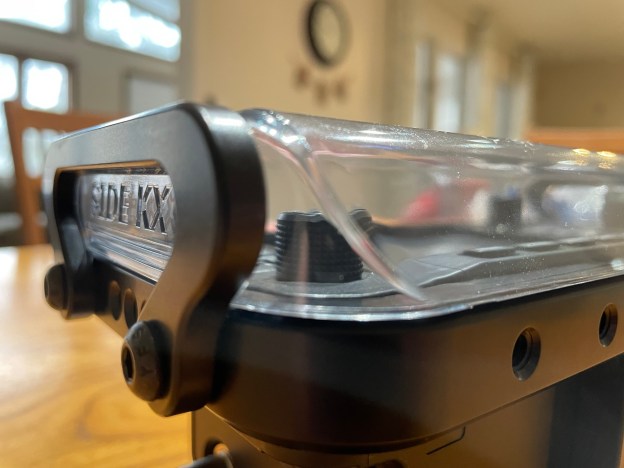
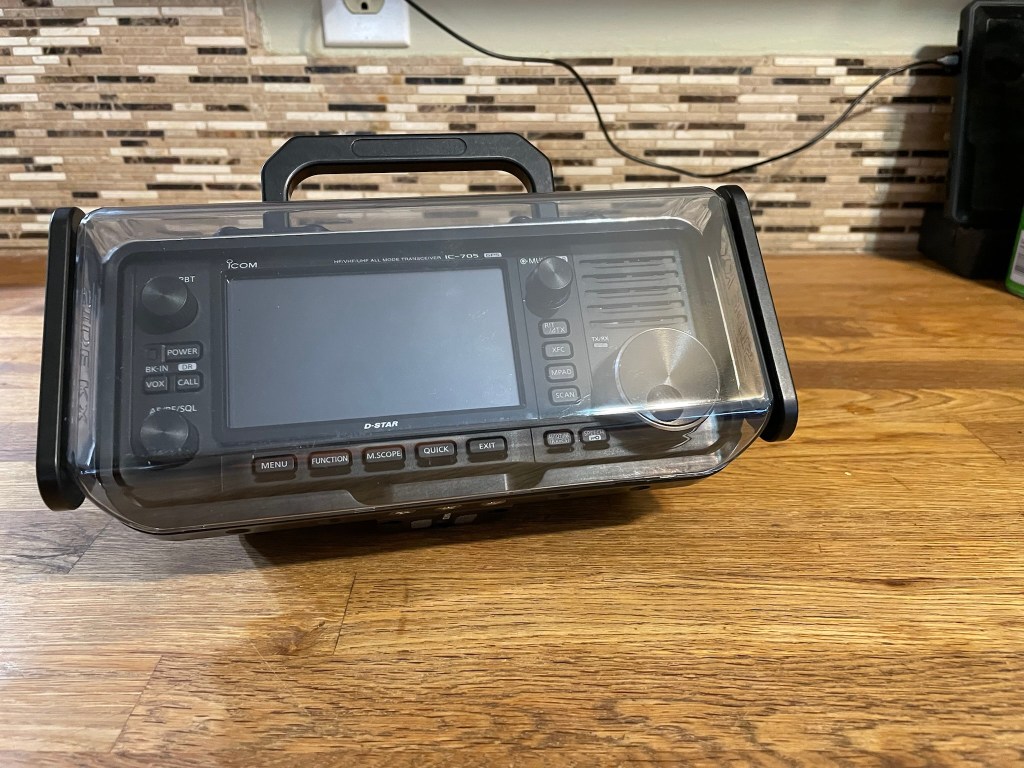
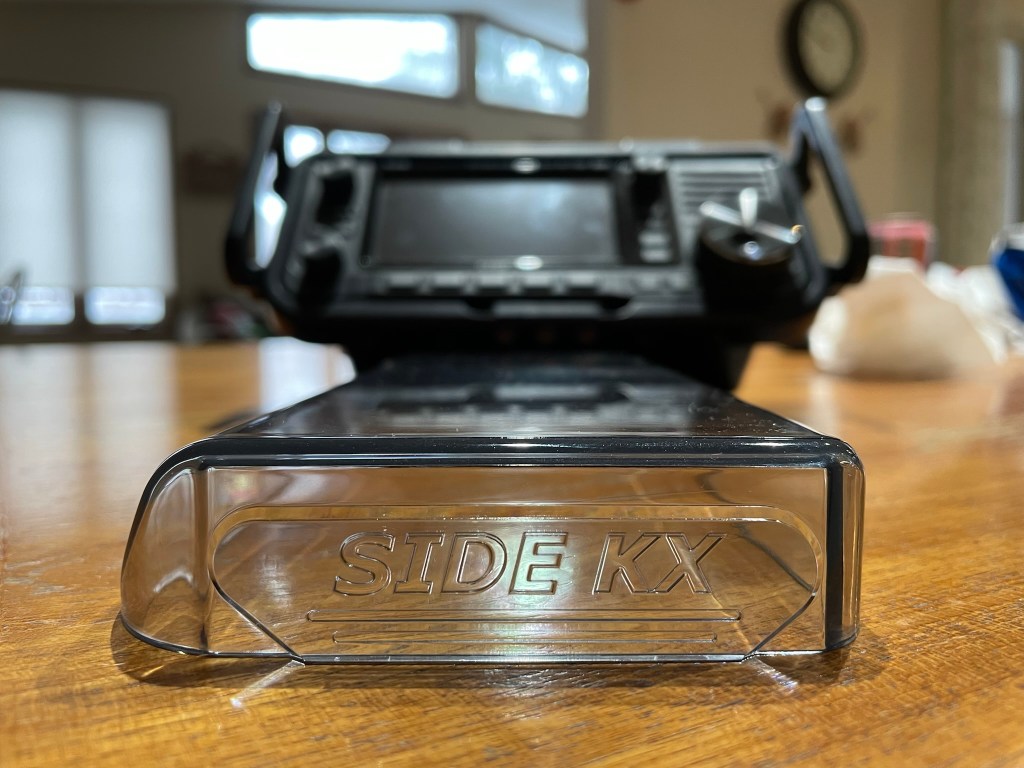
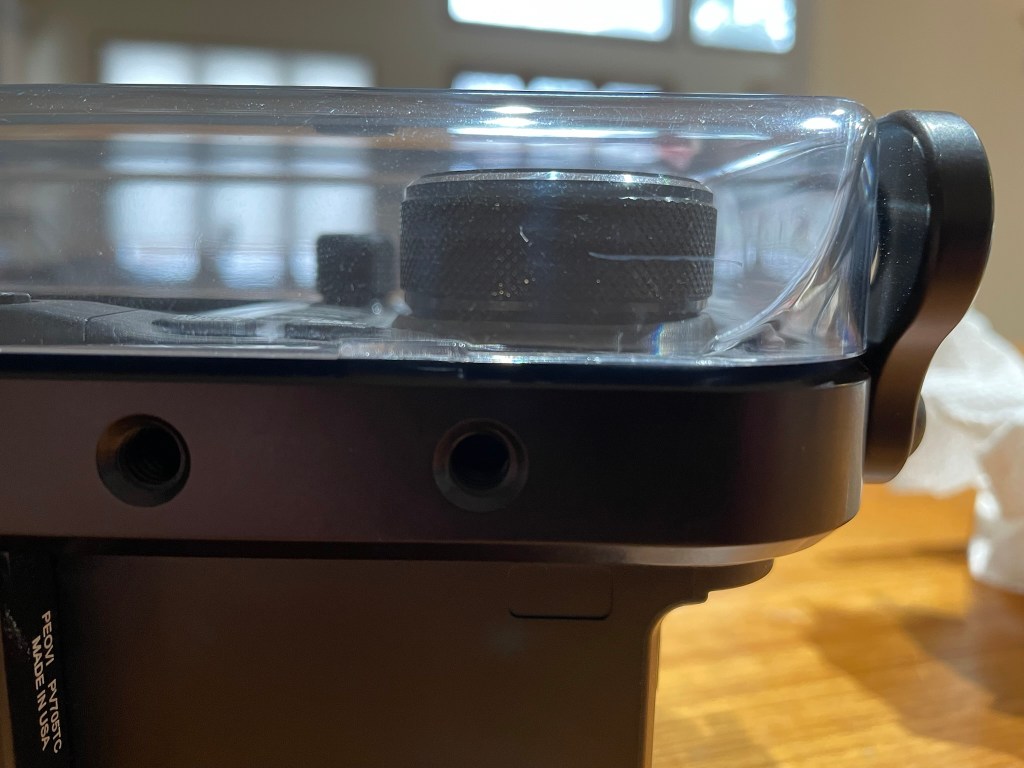
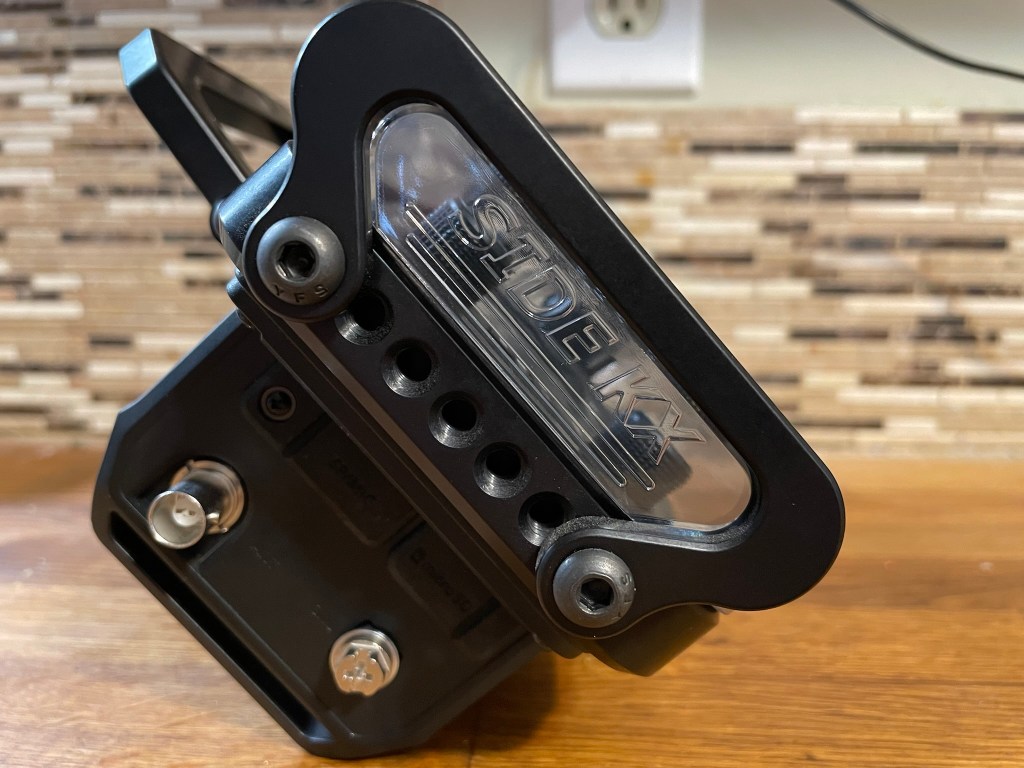
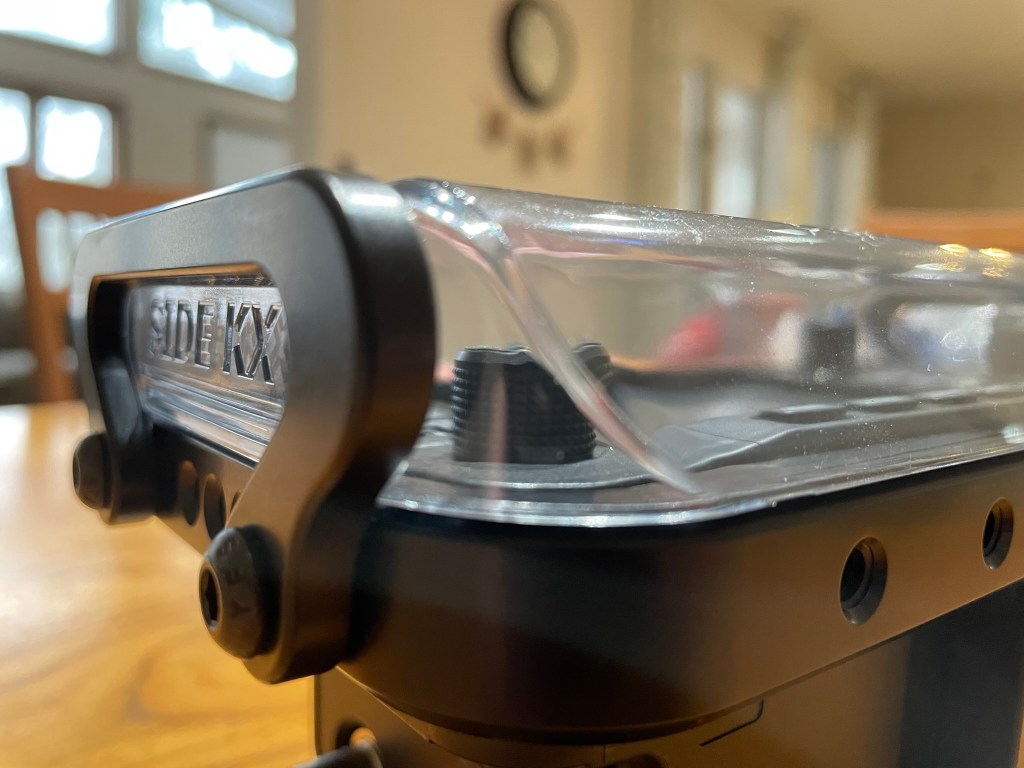
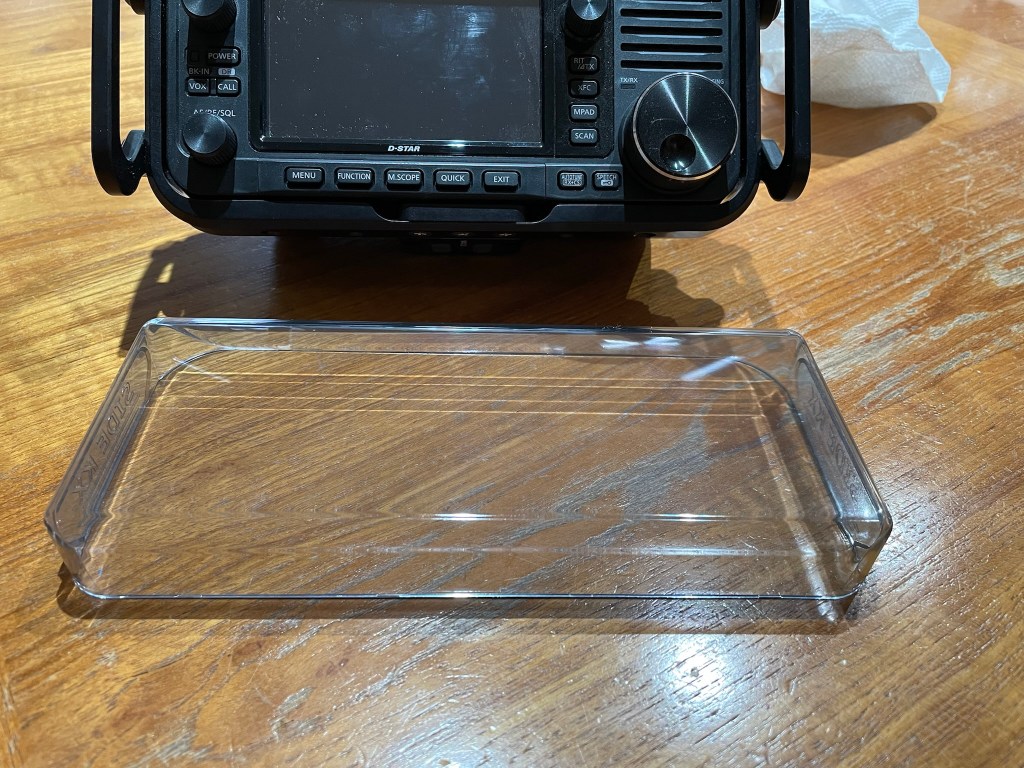
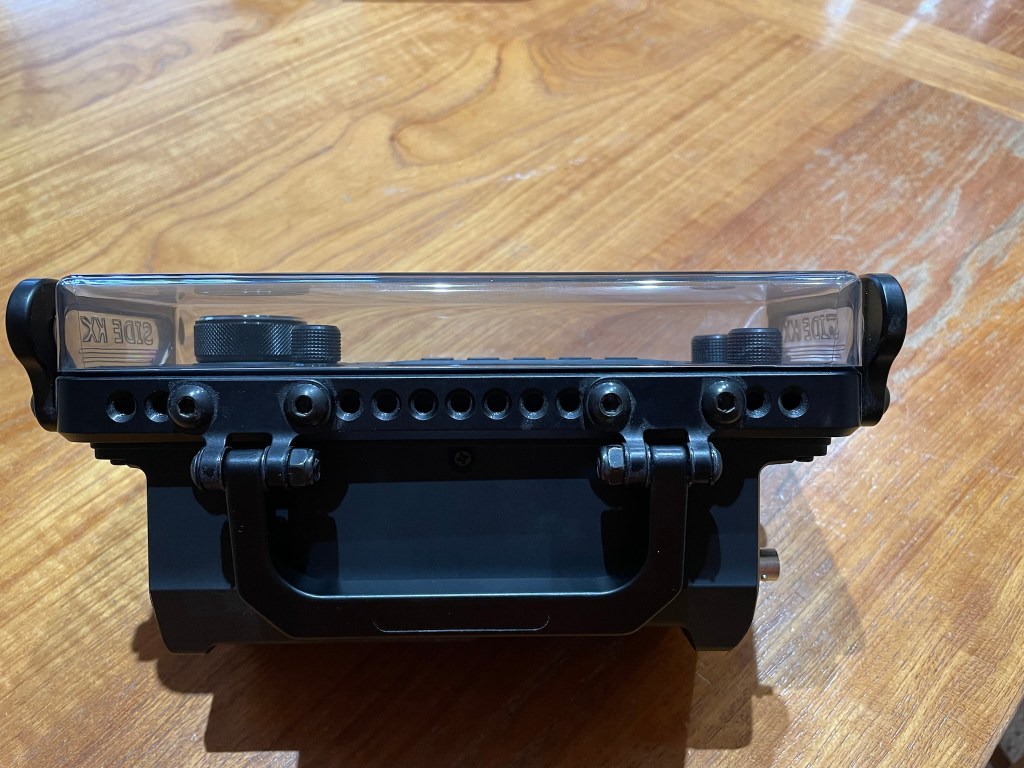
The Side KX Cover for the IC-705 is built very much like the one for the KX3. It fully encloses the face and controls of the radio along all 4 edges with about 1.4mm thick polycarbonate (as my calipers measured it – they’re cheap so it might be accurate 😉 ). The edges have raised sections that fit securely into the openings on the side panels of the Peovi Carry Cage.
It is very lightweight, coming in at 85 grams or about 3 ounces.
All lines and edges are clean and well constructed.
One slight concern is that the tuning knob is fairly close to the right edge of the radio, and when removing the cover it tilts and can touch during the process. Probably not a big deal, but I’ve taken to putting the left edge in before setting the right in place, and doing the reverse when removing to avoid hitting it. This is more of an issue of the design of the radio and how close to the edges the knob is and not about the cover itself.
All edges mate up with the body of the radio and the cage perfectly.
I’ve had this cover for only a few hours, but my previous experience with their KX3 cover leads me to believe that this will be just as durable and protective. As such, I certainly recommend this cover to anyone who has both an IC-705 and the Peovi Carry Cage. It is another layer of protection for this excellent transceiver.
The whole setup does come at a cost that isn’t just monetary – the radio (plus battery), Peovi Carry Cage, and Side KX cover come in at a whopping 1636 grams, or 3lbs 9.5oz! Not lightweight by any means, but this is not a Rockmite or Mountain Topper. 🙂
Pick yours up here. As noted at the beginning, I purchased this item at full price with my own money and have not been influenced in any way to post this review. I have benefited from many other hams and their honest opinions about products, and I hope that this benefits you as well.
On a side note, they have also started selling side panels for the Icom IC-7300 which I also purchased. I might put a quick review of those as well if there is any interest.
Additional photos:
The side pieces are molded to fit just inside the handles, creating enough tension to stay firmly in place but not too hard to removeAnother view of the sides interlocking with the handlesThere is a lot of clearance between the back of the cover’s face and the knobs/buttons







 kd0hbu