v1.13.08 (2022.06.15)
- [BETA] Added CW decoder function
- Extended 10-meter band for TX with taking into account the CB range: from 26065 to 29700KHz
- Added quick mode selection by long pressing the MODE button
- Improved VFO/MEM function: fast switching by TUNE/MULTY between stored VFO values
- Added ability to assign alternative functions to RIT/XIT encoder
- Improved LOCK function in Memory mode
Yesterday I received a new paddle from BaMaTech in Germany – the TP-111 paddle (link).
The TP-111 is a small, ultraportable CW twin paddle from a shop run by Markus Baseler – DL6YYM – and located in Bad Düben, Germany.
There are several products in Markus’ portfolio, from morse keys to antennas. There are even flight decks – portable desks that I’m really interested in looking into more sometime.
Today, however, we’re focused on the TP-111 paddle.
I placed my order on May 22nd and received it on June 14th, and true to the listing on the product webpage, it shipped in about 2 weeks after I placed my order.
The package arrived and was well padded, and even included a small pack of gummy bears. A nice touch.
The key itself is extremely well made. There is an attention to detail here that is to be admired.
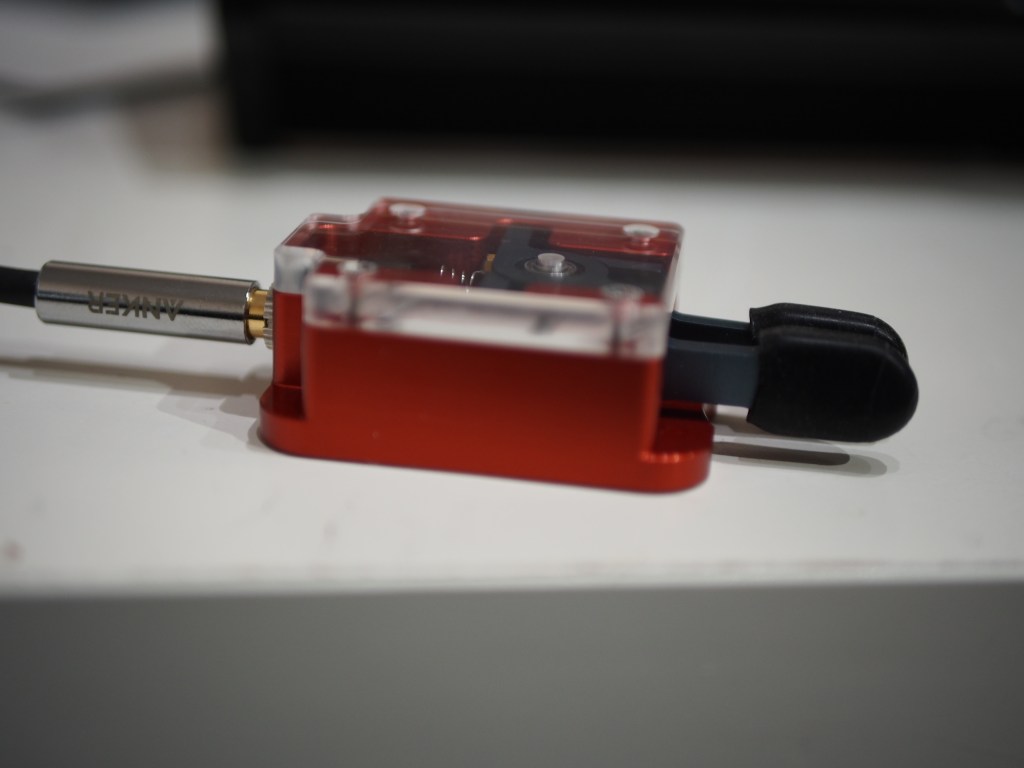
All edges and corners are smooth.
The top acrylic (?) cover mates with the machined base with exactness.
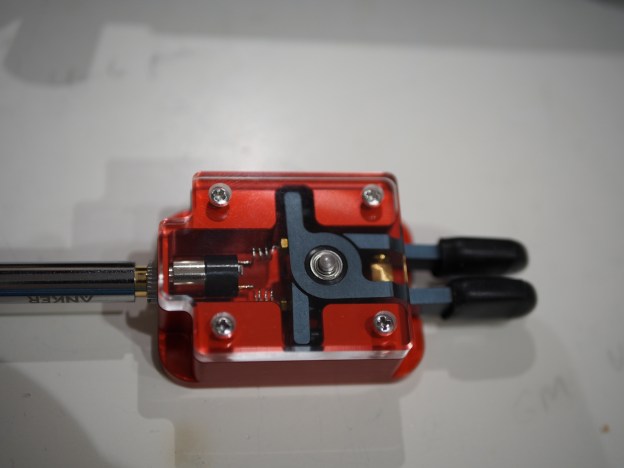
Inside of the key one can see the connection between the port and the paddles, and the soldering is nearly invisible. No blobs of solder or flux to be seen.
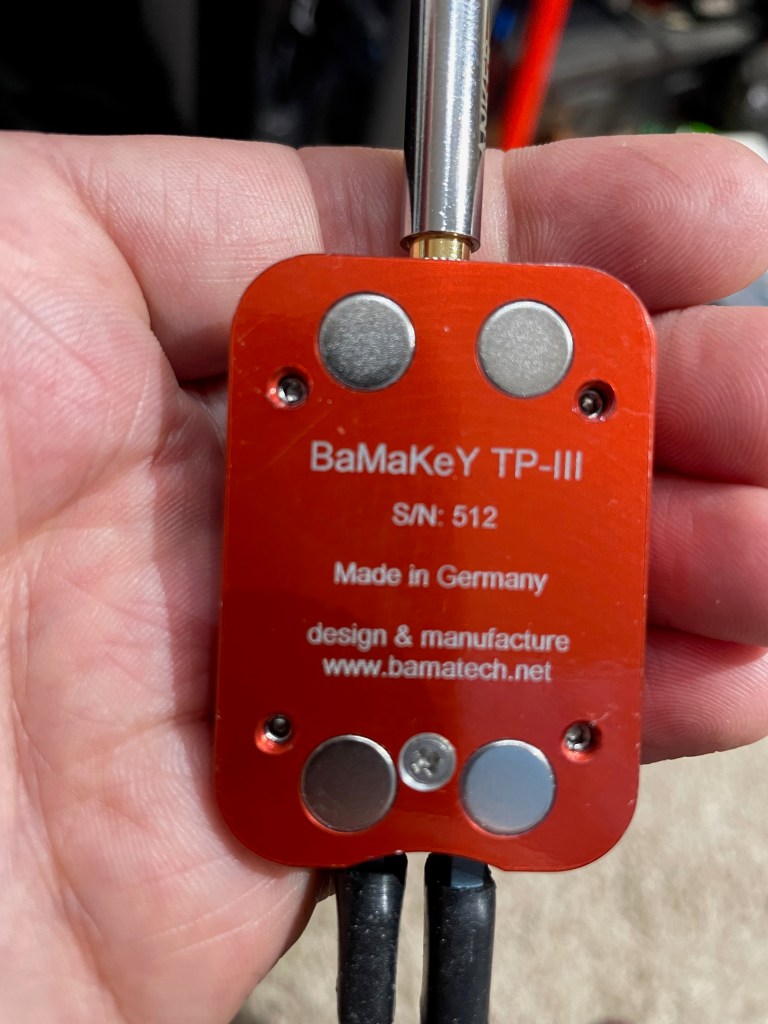
The 4 magnets set into the bottom of the base are flush with the bottom, no gaps and no protrusions.
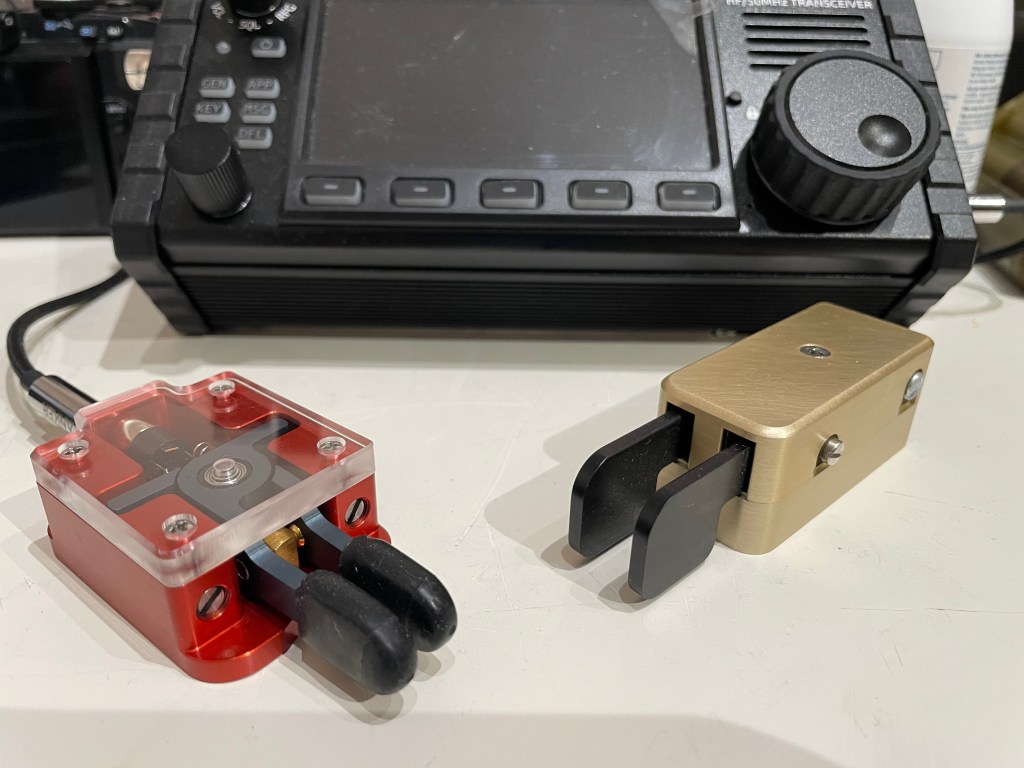
Size-wise it is small enough to go unnoticed inside my portable kit, but not so small that it is cumbersome to use.
The published dimensions are 0.79″ x 1.38″ x 1.97″ (2,87)”, or 20x35x50 (73)mm. The portion in the parens is including the paddles sticking out the front.
The paddles are fantastic. There is a rubber sleeve over each one that ensures solid finger contact and is somewhat “grippy”. (if you rock climb you’ll understand that reference to rubber)
The paddles also move very smoothly with almost no play.
In fact this is where this little paddle really shines – in use.
Upon first hooking up to a radio to generate a sidetone, I was struck by how smooth this thing is. While adjustable, I don’t feel the need to change anything out of the box. I find myself overcompensating movements based on other paddles I own and have to train myself to not need to do so much to get good results.
So how would I rate this? I need more time on the air with it but out of the box I am sold. As always, time will tell, but first impressions are difficult to recover from if not done right.
This paddle gets first impressions right.
It’s even Max-approved.
Right Max?
You can see from below the relative size next to my American Morse Ultra Portable Paddle. Both are superbly built machines.
So if I was a new buyer which one would I get?
Flip a coin. Both are great paddles. Both are well made and adjustable in all ways you’d expect. Both are also quite sturdy in their construction.
If you have one of the BaMaTech paddles, let me know your thoughts in the comments. Agree? Disagree?
Along my CW journey – which I am still trudging along on – I have benefited greatly from Kurt Zoglmann (AD0WE) and his site Morse Code Ninja (link).
Kurt has produced literally weeks and weeks of audio files of various categories in speeds of 15-50wpm (*gulp* – that speed just sounds like noise to me still), all of which is freely available for download. You can see the dozens of categories on his Practice page (link).
His YouTube channel additionally has videos of the audio files so you have multiple options for playback.
Example Video
Given how many hours I’ve spent using his work over the last year plus of my learning CW, and how many others I’ve spoken with that have also benefited, I am suggesting that a small donation to continue to fund his efforts is a good thing that, if able, you should consider doing.
He has a link to do so on his contact page (link).
No I am not affiliated with him or his site, just a very grateful consumer of his efforts.
Having a software development background I know how time intensive projects like his can be, and for him to put it out there for everyone to use freely speaks to his love for the hobby and desire to grow it even more. Hosting a website and having bandwidth for file download isn’t cheap, and I like to encourage people like him to continue so that we can all benefit for years to come.
The folks over at Icom released a firmware update today.
It looks to be a fairly minor change, but you can decide that.
From the change log:
Improved to enable forcing an All Reset by connecting an external power source (*) while holding down [RIT/ΔTX] and [XFC], even if you cannot turn ON/OFF the transceiver by using the [POWER] key.




 kd0hbu