The folks at Xiegu have provided minor updates to their popular G90 and the newer G106 transceivers.
G90 Changelog
UPDATE DISP UNIT ONLY!!
File: G90_DispUnit_Fw_V1.80
SHA-256: B0730B08500DFDD2BA767B390CD349606252B0B44FBBA7DE3130F192A1493F3A

[EN]
1. To work with JTDX/WSJTX (or some other data mode softwares), add CI-V commands 0x25,0x26,
   See <<XIEGU RADIO CI-V REFERENCE>> and <<XIEGU RADIO JTDX WSJTX SETTINGs>>
2. Add CI-V command 0x1d 0x19, read the XIEGU RADIO ID,
   See <<XIEGU RADIO CI-V REFERENCE>>
And for the G106
[EN]
1. To work with JTDX/WSJTX (or some other data mode softwares), add CI-V commands 0x25,0x26,
   See <<XIEGU RADIO CI-V REFERENCE>> and <<XIEGU RADIO JTDX WSJTX SETTINGs>>
2. Add CI-V command 0x1d 0x19, read the XIEGU RADIO ID,
   See <<XIEGU RADIO CI-V REFERENCE>>
3. Bug fix: Can't totally mute when RX volum set to 0
4. Bug fix: ACC TRX Pin is output only (now it's bidirectional)
5. Bug fix: Won't lock the long press key
6. Set RX audio bandwidth to 10~3300Hz in data mode
Neither brings with it substantive capability updates, but always nice to see a company continue to update their offerings.
Looking at the Transmit Range row above, something stood out right away – where is 7.21 – 7.30 MHz?
Checking the website showed the range as 7.0-7.3 MHz as I would expect, and I can confirm that you are indeed able to transmit between 7.21 and 7.30 MHz.
While I am generally a CW operator, that would have been a serious omission.
In the Box
Not much.
You get the radio, an non-terminated power cable, a handheld mic, and some papers that include a printed manual.
I’m not huge on the “unboxing” type experiences. For me it is a once-and-done experience. If that is your thing….sorry. This is a fairly spartan box.
The Radio
Now on to the main course.
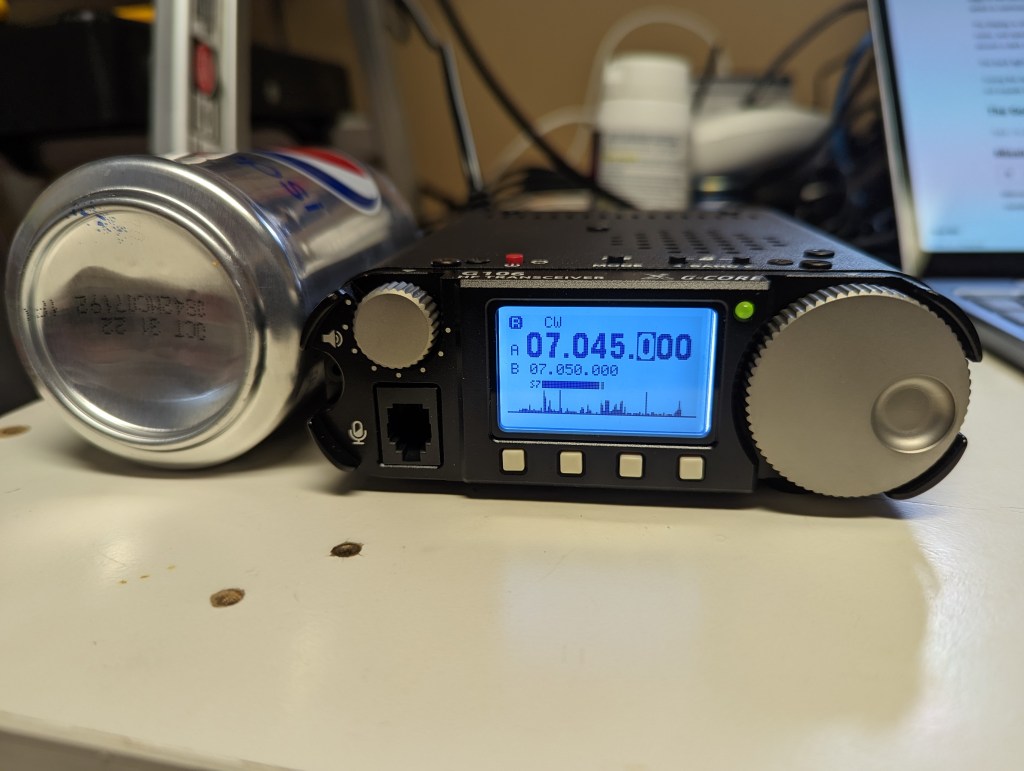
The radio is smaller than I expected, but feels quite heavy and robust in the hand. Here is a soda can for reference:
Controls are minimal:
Two knobs (that double as push buttons) that control volume and tuning
4 faceplate buttons (what these control changes depending on what menu page you’re on)
4 top buttons (power, mode/preamp, band adjustment/lock
Moving towards the back panel we have a BNC antenna interface, ground lug, key interface, comm interface, acc interface, and power input port.
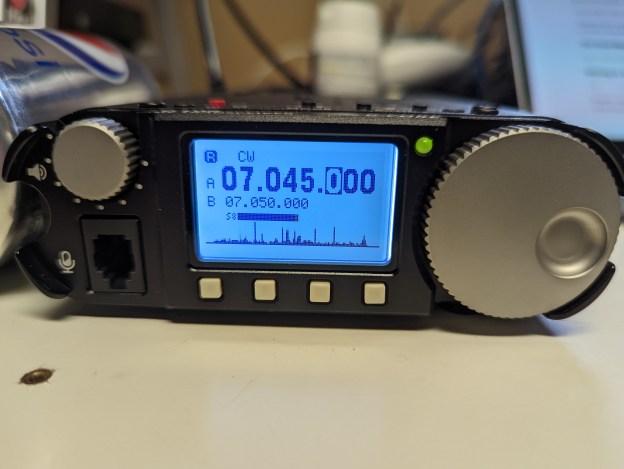
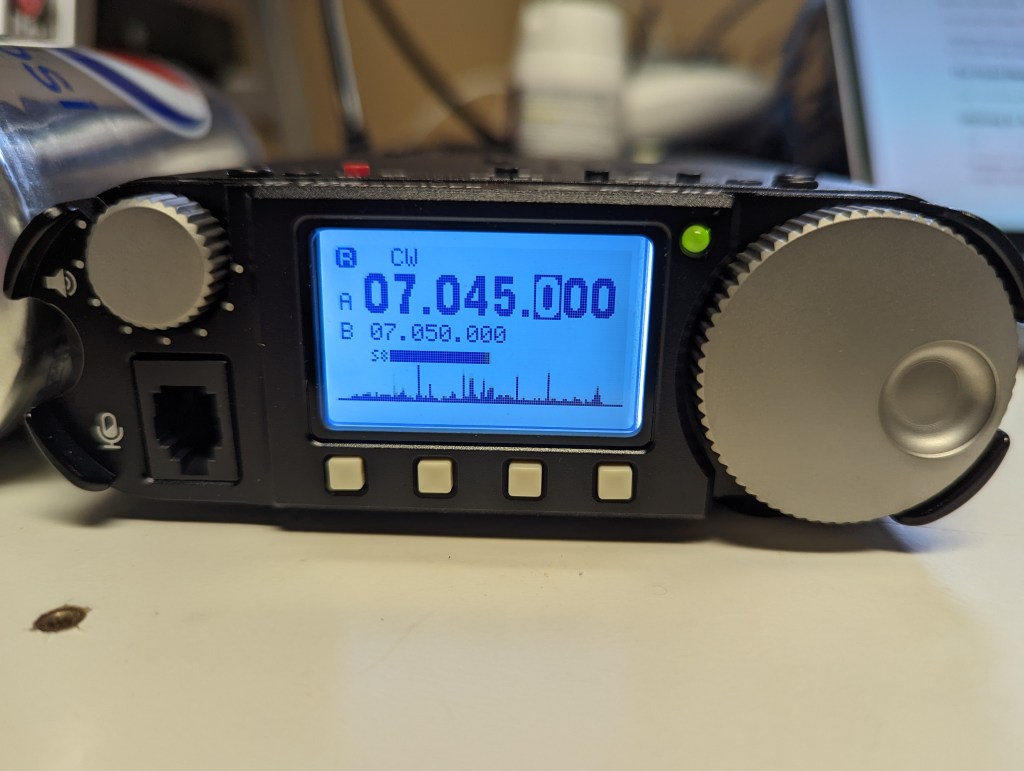
The display is simple, well laid out, and gives the important pieces that I use most: mode, frequency, S-meter, and spectrum display. The background is a white with slight blue tinge color, and the foreground is almost a dark navy blue. Not quite black.
The back light is either on or off, no adjustment available.
Tuning the radio is very pleasant. The large knob has small palpable steps that provide feedback but do not impede tuning when you’re trying to move fast.
Underneath is bare except for 4 rubber feet that it sits on. The side panels are equally bare.
The Good News
Most of the things I expect and use in a radio are there today.
CW settings for type, speed, tone, and QSK are all adjustable. CW filtering bandwidth is also adjustable in increments of 50/250/500 Hz.
It is multi-band and multi-mode, including digital.
The spectrum display reminds me quite a bit of the one on the Lab599 TX-500. If you’ve seen the Xiegu x5105 then you’ve seen this one as well.
With volume adjusted, the audio was surprisingly clear. The onboard speaker can (as noted below) become overwhelmed. I’m working on recording some audio samples and will upload when ready for reference.
Operation is quite simple and I think the controls are a bit more intuitive than their other transceivers. The menu navigation is easy to do and I didn’t have to reference the manual once in order to do basic operations. Their UX is getting better in my opinion.
Missing in Action
There are a few things missing from this radio, at least in my opinion.
Memories – there are frequency memories but not the type one might use a lot with a portable radio for SOTA/POTA operating, namely memory banks to store recorded messages. I’m not a constant user of such, but they are nice to have in cooler weather when my fist becomes an ice block.
There doesn’t seem to be any sort of automatic gain control and the onboard speaker can quickly become overwhelmed on strong signals.
Beware if you’re using a headset!
Unlike their other radios, there is no built-in battery. This isn’t necessarily a con for many, but want to call it out.
Also unlike the x5105 and x6100, it does not have a automatic antenna tuner.
There may be other things that you depend on that are also missing as well. This is certainly not an exhaustive list.
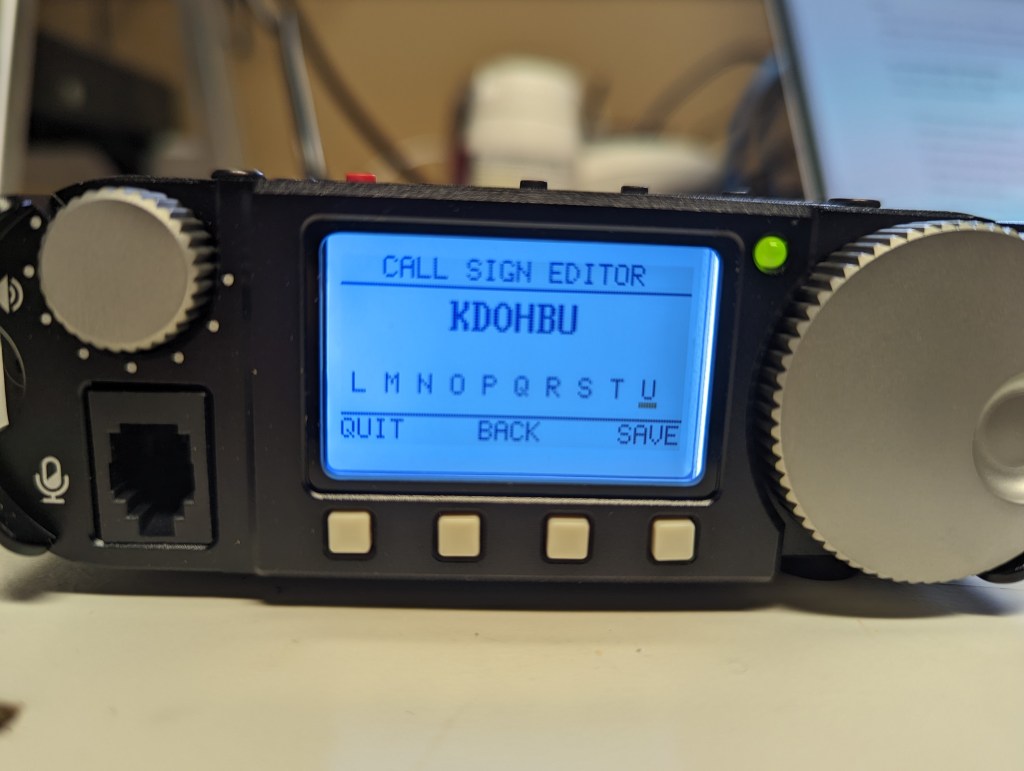
Setting my callsign to display on startup
Conclusion
Coming in at half the price as their current top-end HF transceiver, the x6100 and in a form-factor that is more like the Yaesu FT-817/818, it is an interesting radio.
Having just received it today I haven’t yet had it out in the field, but I have to say I’m both pleased and a bit torn. On the one hand this I see myself much more likely to take this out when I may be places that would be a bit more dangerous for something like a KX2/3 or the IC-705 (I’m paranoid about my radios). It performs what is generally needed and is simple to operate.
It is small and seems quite robust.
But I’m struggling to see why I’d grab this one and not the x5105. Yes it is smaller, but having charged the x5105 I can grab that and a wire antenna and go.
I think I’m gonna keep this one though. There is potential here and who knows what Xiegu will add in a future update, but this may not be something that meets many operators’ needs.


 kd0hbu