I’m currently comfortable at a sustained 12-13wpm, or that spacing with a Farnsworth at 20+. I’m hoping to bring my sustained to 20wpm by the end of this course.
I first saw this kit online this last summer and was immediately intrigued. Fast forward to obtaining the December 2021 edition of QST where they did a review of the radio, and I knew I needed to get one.
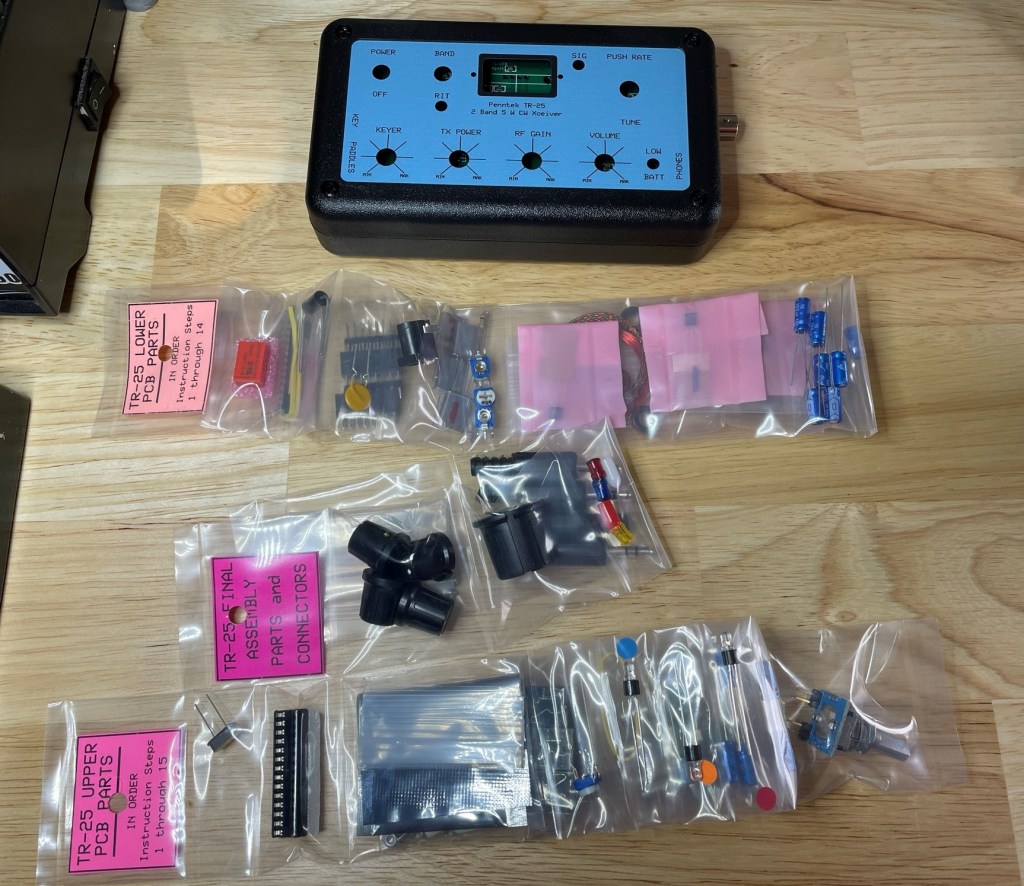
The kit arrived in a well packed box about 1 week after placing my order. Unpacking it I have the following contents:
The PCBs are packed inside the radio case, and all the individual parts are packed together based on which part of the radio is being assembled.
For example, all the lower PCB parts are packed together and separate from the upper PCB parts. Even more convenient is that within each set of parts, each one is organized in the order of assembly. A welcome usability improvement over other kits I’ve done where parts arrive loose in a single plastic bag.
Also included are print outs of the assembly manuals, which are likewise separate pages for each section
Installation of all components is very straight forward. If you can solder, you can install all the parts.
There are 6 toroids that need winding. None are overly difficult (I still have flashbacks of T1 on the QCX mini ;)). The directions are very easy to follow and there are picture to validate your windings against.
I’m not going to go through a step-by-step of the assembly – the manuals do that for you. K0SSK also has a great post showing assembly and testing of the kit.
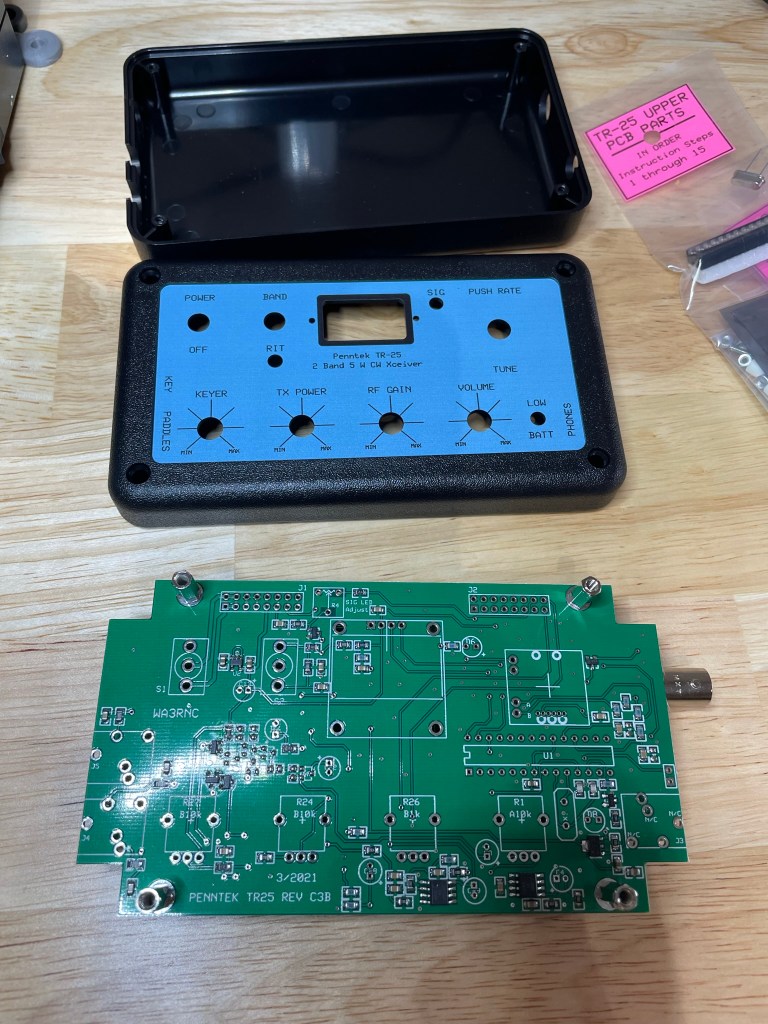
Assembled minus the bottom half of the case – need access to the pots to perform final checks and adjustments. Nice clear OLED screen. Always makes me smile to see things work as expected, even more so that I didn’t let the magic smoke out. 🙂
Quick Comparison
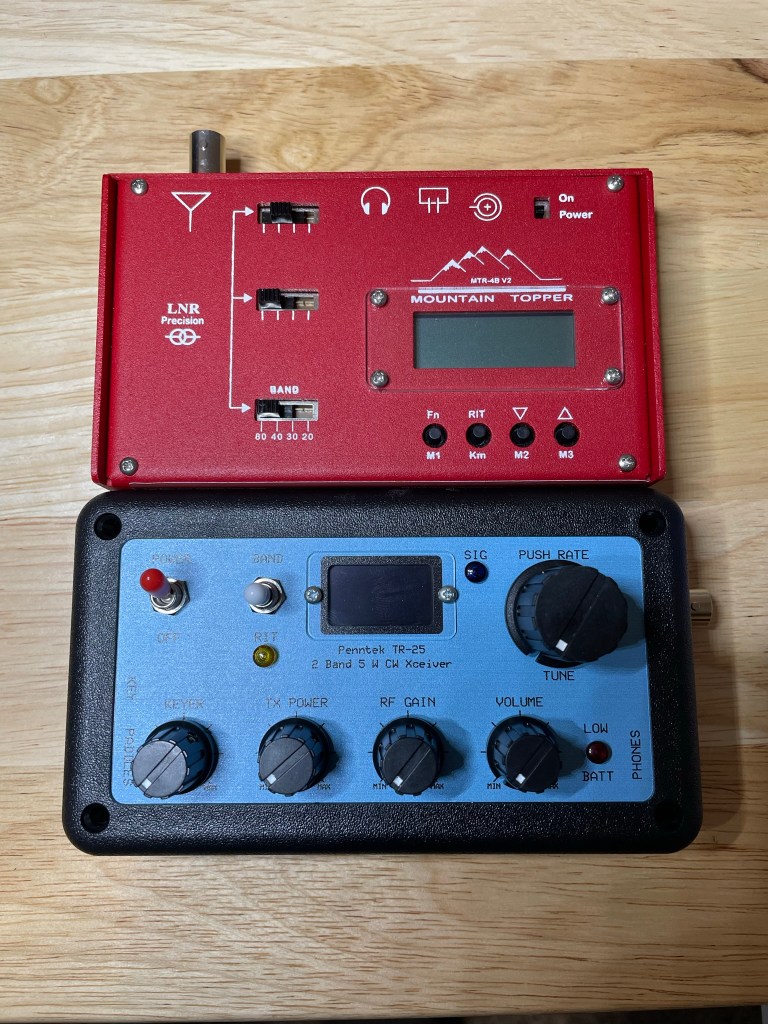
Looking at my other radios, the size lends itself to being compared with my Mountain Topper from LnR Precision.
Both come in at roughly the same dimensions. The Mountain Topper is 4 bands (80/40/30/20) compared to the TR-25’s 2 bands (20/40). While both radios offer QRP portability for commonly used bands, you can see that the tradeoff is either usability (a control for everything) vs breadth of capabilities (more bands, memory slots, etc.).
It is a little of an apple and orange comparison when putting a commercially built radio up against a kit given that the MTR comes assembled, but it is the only multi-band radio that is close to the TR-25 in my collection.
Minor Nits
There are a few things missing from this radio that others have, such as:
No memory slots for recorded SOTA/POTA/CQ messages
No visual indication of WPM for the Iambic-B (there is no Iambic-A support) keyer, the dial simply has Min/Max markers
The design is intuitive and having a dial/knob/toggle for all settings is actually nice thing given how many radios use menu and sub-menus to death, but they do stick up from the radio and might be subject to being broken in the field – time will tell
These are minor nits in my opinion as not everybody needs every bell and whistle to enjoy SOTA/POTA/QRP operations.
Conclusion
This post is focused on the quality of the kit and what I received for my money. I have not yet gotten in on the air and will follow up with my impressions there. For now, keeping things focused on the kit building side.
The TR-25 is easy to assemble, with 4-9 watts of output depending on band and power input, no hideous menu structures to memorize (everything has a switch or knob on the face). A great little radio that can be put together and be on the air quickly and easily.
NOTE: Penntek is coming out with the TR-45L 4 band transceiver that is currently in beta testing. It looks a bit “old school” and I’m definitely intrigued.
I’ve been done with the CWOps Basic Course now for a couple of weeks and felt that it was time to post my thoughts on being a participant of the program and what I got out of it.
They offer multiple courses for different skill levels.
Beginner (Introduction to CW and learning the characters)
Basic (Build head copy skills and on-air QSOs)
Intermediate (Recognize words as sounds, increase head copy speed)
Advanced (Move rocks with your mind while wearing a Jedi master as a backpack)
Ok, I made that last description up, but you can see the progression from start to finish and Advanced is really about getting that speed up which includes contesting speeds of greater than 30wpm.
Already having spent quite a bit of time learning the characters, I started with the Basics course. This is very much a student driven course. That means that they have developed the program which lasts 8 weeks, and have setup practice routines for every day in-between. It is up to the student to drive their own practice and effort. Students then meet twice weekly as a group with a CWOps Advisor.
Classes are virtual and make use of both audio and video to ensure that everyone is able to interact as necessary. We practice using Farnsworth at 20+wpm and begin at 6wpm spacing, ramping up to 12-14 by the end.
Personally, having a group of like-minded individuals that were coming together at relatively similar skill levels to converse and grow together made a huge difference in my advancement in CW. This honestly surprised me as I tend to be more introverted by nature.
Our advisor was Christopher Barber – WX5CW – and I couldn’t have asked for a better mentor. He is driven for his student’s success, passionate about CW and getting on-air, and a generally great guy. Always available to answer questions, as we progressed in the class he even took time out of his weekends to try and get on the air for practice between sessions.
All that while balancing work and family.
At the start of the program in late-August, I had done a couple of “QSOs” (I use quotes since they were embarrassingly bad on my part and sometimes incomplete).
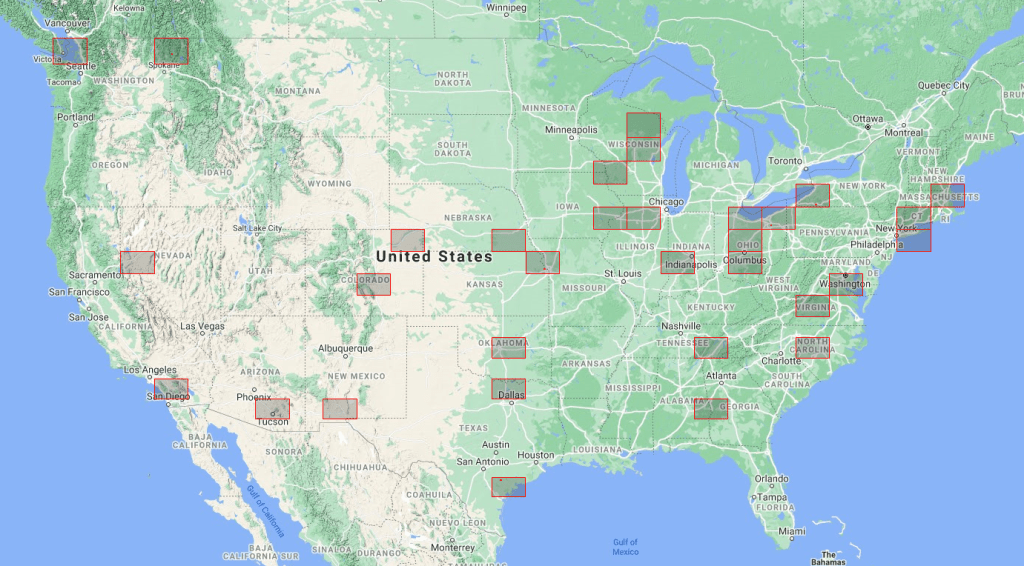
Having just completed the course, I’ve racked up 30+ QSOs all across the US and have even done one POTA activation. I am operating at 13-14wpm, whereas I was previously stumbling through a QSO at 6-8wpm (if that).
Instead of abject terror when I send a CW, I am incredibly more comfortable copying what I hear and even asking for clarity when I cannot do so (instead of fearing a whole new onslaught of dits and dahs that I won’t understand).
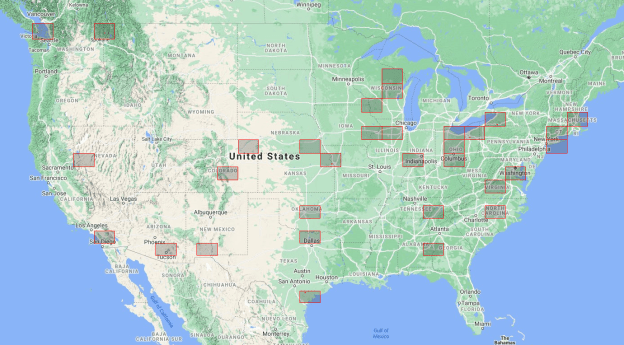
They say that the “proof is in the pudding”:
How do you like that pudding? Each grid square is a CW QSO that I’ve done since the start of the class. None of my classmates are included above – all are random on-air QSOs with strangers.
Verdict
In the end, I cannot recommend CWOps courses highly enough. You will get out of it what you put in, but I believe that for any skill level they have a well thought out course and anyone looking to become more proficient in CW would benefit in some way.
Classes run three times each year, and you can sign up at their registration page.
I’m signing up for the Intermediate course if that tells you anything.




 kd0hbu