
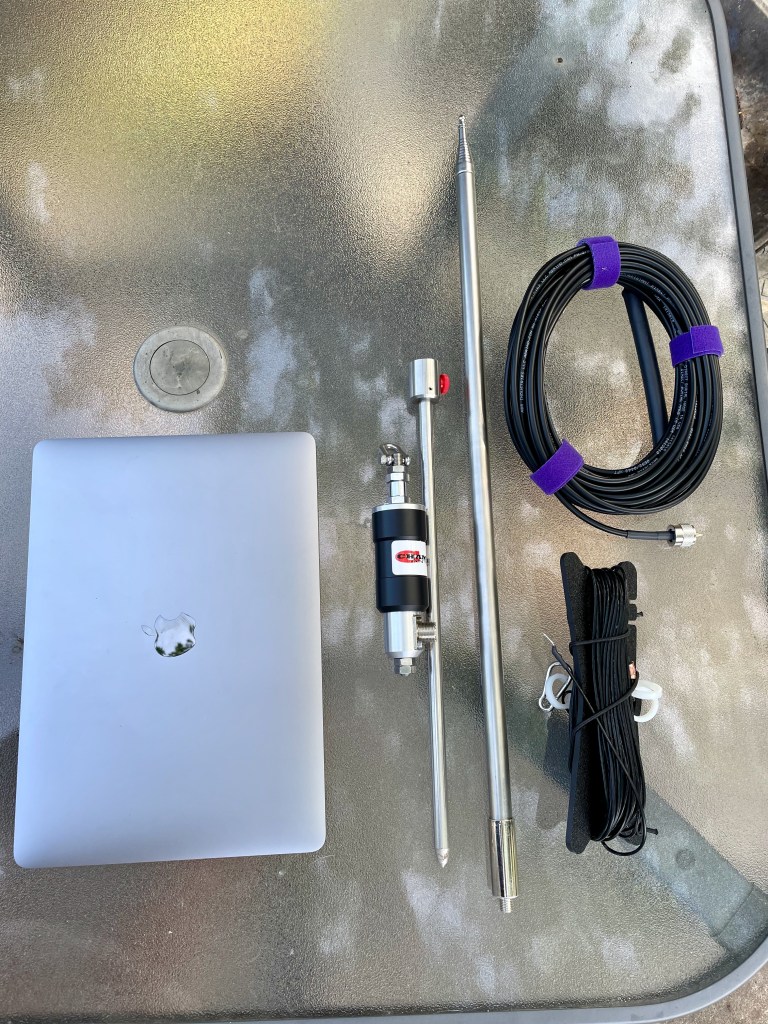
chameleon antenna mpas lite

Macbook Air for scale (not included)

I just received my MPAS Lite from DXEngineering.

Pros:

  • Super quick setup – from start to finish was perhaps 2 minutes for the vertical configuration (oh yeah, this thing can be setup multiple ways)
  • Sturdy – I don’t have any other antenna that has hardware as beefy as this thing is
  • Resonant (!?) – To my complete surprise, though it shouldn’t have been had I read the manual – I got fairly low SWRs on most of the bands I checked, and my x5105 could tune the rest

Cons:

  • Length – The 17′ whip compacts down to about 2 feet or so, which means it sticks out the top of my GR1. I’m trying to figure out how I want to handle packing this thing so that I don’t have the whip get snagged on things, etc. Perhaps bring a bigger pack? Any suggestions?
  • Heavy – This one I’m going to caveat with two points; this thing is sturdy and has few parts, so from a weight perspective it is about on par with the other portable verticals that I own, and given the few parts that need to be kept track of, I don’t think weight is that big of a deal. It probably equals out with my other verticals, but definitely outweighs my dipoles.

We tend to tout the latest rig that costs hundreds or thousands, but frown on any antenna that isn’t made from $6 speaker wire. Speaking as someone who has built <insert insane number here> antennas from all kinds of cheap parts, and found them to be incredibly effective, there is nothing wrong with that. I’m just saying that sometimes investing in all the components of our radio setup is important.

How does it compare to my Buddistick or my Super Antenna MP1? I spend all kinds of time fiddling with both of those when I setup in the yard or field. In all the years I’ve owned my Buddistick, I’ve never been able to get the little mini-banana clips to tune the same way each time. The MP1 has a card that you use to line up the tuner on the coils, but that is ballpark and I still play with it until its good.

This thing is unpack, stick in the ground, unroll 25 feet of counterpoise, hook up the coax (included), and go. Per their manual, and backed up by my SWR meter, it is <2.0 on 30, 20, 17, 15, and 12 meters. It is also (in the vertical configuration) 1.8-1.9 on 40m. The manual says 2.0 – and as you can see I got better than that. The lower bands (60m and lower) are 3.0+.

Bring a tuner for those.

If you go with the end-fed inverted “V” configuration, then the numbers are even better starting out for the lower bands. Some of the upper bands like 17m and 12m do go above 2.0 though, with 40m around 3.0.

This thing solved for the majority of cases where I’m taking my KX3 or my x5105 out to play radio. For my MTR4B v2 or kit builds, I will probably stick with a resonant dipole hung in a tree (no tuners on those).

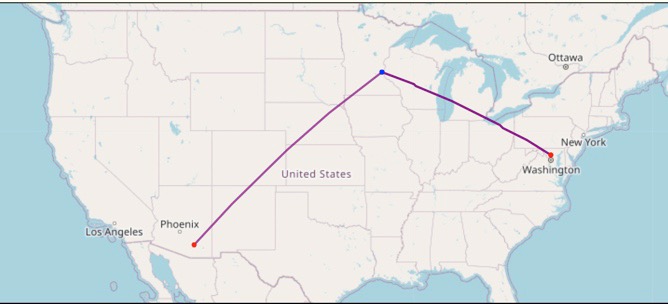
Did a quick RBN call to check propagation. As you can see below with 5 watts and the MPAS Lite, 929 miles (1490km) to one spot, and 1287 miles (2071km) to another isn’t bad from my backyard. And that is between a chain link fence and our home with aluminum siding.
This is my second Chameleon Antenna product, and I think they’ve hit a sweet spot between portability, durability, and ease of use. These are not built in a garage somewhere, but are made for the harshest conditions and it shows. It comes with a price tag, but consider that you’re investing in something that is made for being used, packed up, used again, packed up again, ……

qrp radios

This year I decided to learn CW (for the nth time).

I mean to finally learn CW and actually use it going forward. I also wanted to start operating from the field as much as possible.

As such, I started to acquire some mobile rigs – mostly QRP – to push me to make good on my investment and spend the time practicing CW and getting on the air. The good news is that I made my first CW contact on Memorial Day this year. My QTH introduces a lot of RFI so the QSO was quick and dirty, but we exchanged callsigns and actually did a follow up email or two.

I’m hooked.

However I looked around my home office and realized that I’ve got a few rigs now.

Quite a few.

So I’m putting together this comparison chart both for my own reference, but hopefully for yours as well.

Now, which radio to use next…..

RadioModesBandsWattsVoltageNotes
Elecraft KX3All160m-6m0.1-109-15VDCThe Cadillac of my QRP rigs
Xiegu x5105All160m-6m0.1-59-15VDCBuilt in 12v 3800mah battery
LnR Precision MTR4B v2CW40m, 30m 20m, 10m55.5-12VDCDo not use more than 13v supply
Ten-Tec R4020CW40m, 20m59-14VDCCan receive SSB
QRP Labs QCX-miniCWSingle Band (mine is 40m)57-14VDCKit – high quality components, great documentation
Many options, each with its own awesomeness

Random Thoughts

Largest to smallest, which almost corresponds to feature sets as well

Elecraft KX3

I do not know where to begin. I purchased mine used and upon first boot, was blown away by the receive capabilities, filtering, etc. It is a robust, feature-rich, and portable transceiver that checks all the boxes and does so in a first class manner

Xiegu x5105

This is the latest addition to my kit. Radioddity.com had a great 2021 Field Day sale on these that came with the CE-19 adapter and a custom backpack. I took this in the woods all last week in northeast Wisconsin. The built-in battery pack that can be charged while it is in use is amazing. The retracting feet put it at just the right viewing angle. There are some nits such as latent noise when on headphones, but being slightly smaller (and significantly cheaper – less fear of breakage) than the KX3 means that I’m looking to use it more often.

LnR Precision MTR4B v2 (Mountain Topper)

Wow. So on opening the package I was amazed at the build quality here. Sturdy case, compact size, and a lot of built in features make this little rig a favorite of mine. Part of the compactness means that you give up a couple of things that other rigs offer – no volume control (watch those strong signals), no ATU (use a resonant antenna – problem solved), and a lower voltage input before you start to max out the PA FETs. It has built in message memories, beacon mode, and more.

The voltage input is the biggest issue with me for this rig – I have a couple of 3s LiPo batteries that I use just for this radio – but that is a minor nit given the great receive and overall performance that comes with it. Given that you can run this thing off a standard 9v smoke alarm battery, I’m not complaining (too loudly 😉 )

By the way, Amazon has a great and inexpensive case that fits the MTR4B v2 and power cable with adapter for Powerpoles to XT-60. You can find it here.

TEN-TEC R4020

I picked this up the last time I thought I was going to learn CW. It has largely sat unused fora few years, but I do pull it out on occasion. Small, easy to use, and built in AA battery tray (bring a screwdriver to open/replace batteries). Not much to say here other than it is capable and when I bought mine on Ebay, was relatively cheap for the quality.

QRP Labs QCX-mini 40m

This is a kit build and I strongly recommend it as both a great build experience and a great little radio. It is half the size of the LnR Mountain Topper above, has a built in CW decoder, volume control, message memories, and more. With the exception of one toroid that is somewhat more complex to wind than most I’ve done, it goes together easily with some of the most comprehensive and easy to follow instructions that I’ve ever seen in a kit. If you want to dive into kit building, or just want another one to add to your shack, I cannot recommend this one highly enough. For the price (<$100USD with a solid metal case), it is top notch.